Architecture
How the driver is built: three layers, one of them yours, and what happens in each when you read the angle.
Datasheet sections this page relies on
From ams OSRAM DS000637 v1-01:
- SPI mode, frames and the read pipeline: SPI Interface (Slave); SPI Transaction, p. 16
All of them, with the driver API for each: Datasheet map.
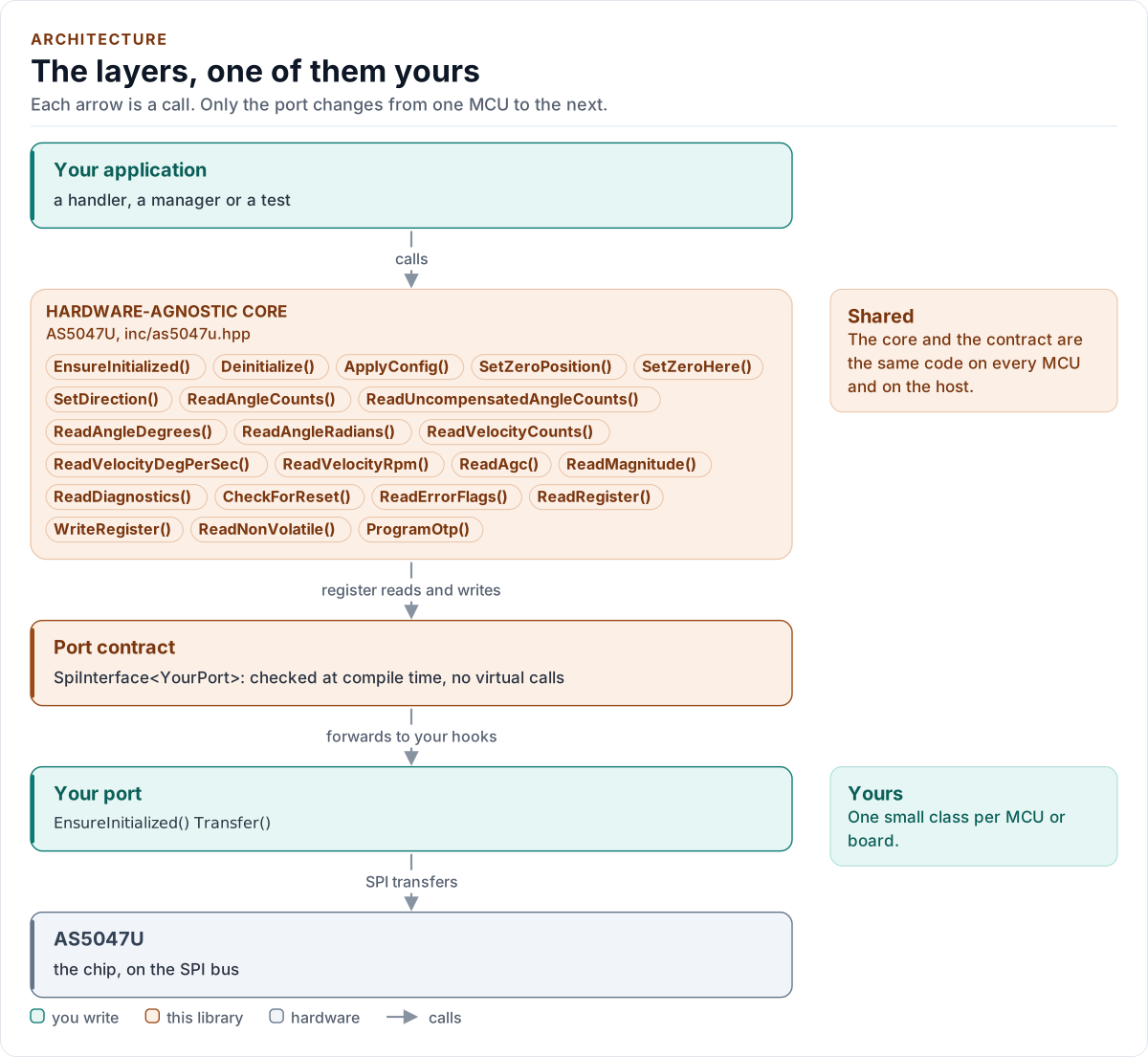
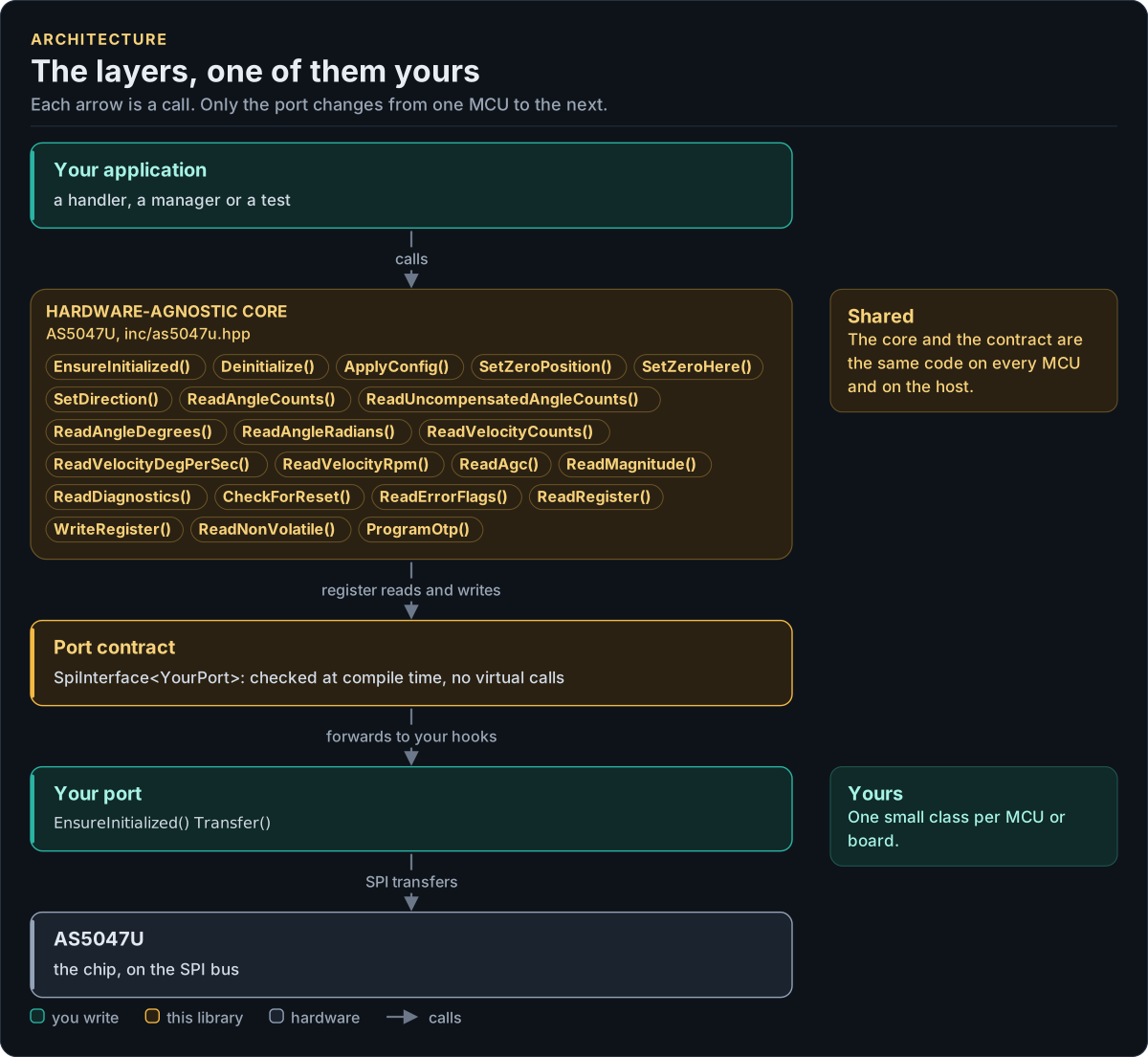
Figure description and sources
Top to bottom, each arrow is a call. Your application calls one object, whose public calls are listed from the umbrella header in inc/. The core turns each call into register reads and writes and hands them to the port contract (the CRTP base in inc/*_interface.hpp), which forwards them, at compile time, to the hooks of the port class you write; your port moves the bytes on the bus. The notes on the right say which layers stay the same on every MCU and which one you write. A library without a port contract has only the first two layers.
Drawn from: inc/as5047u.hpp public calls; inc/as5047u_spi_interface.hpp SpiInterface; figure module docs/diagrams/figures/driver-layers.py.
Layers
| Layer | Files | Owns |
|---|---|---|
| Core | inc/as5047u.hpp, src/as5047u.ipp |
Lifecycle, configuration, read and write sequences, ERRFL handling, unit conversion, the OTP procedure, errors |
| Types and registers | inc/as5047u_types.hpp, inc/as5047u_registers.hpp |
Error, Result<T>, Config, Validate(), the decoded ERRFL and DIA, OtpReport, OtpBurnConfirm; the register map and the CRC parameters |
| Compile-time helpers | inc/as5047u_detail.hpp |
detail::ExactHook<Port, Sig> (exact hook matching), kAlwaysFalse, ToUnderlying(), IsEnumerator() |
| Port contract | inc/as5047u_spi_interface.hpp |
The bus requirements as constexpr, the CRTP base, the SpiPort concept, Crc8() and the frame layer (16, 24 and 32 bits) |
| Platform port | Your class | Bus bring-up and byte transfers, the delay and optionally logging |
| Kconfig layer | inc/as5047u_kconfig.hpp |
Optional: a Config from ESP-IDF menuconfig |
One call through the layers
sequenceDiagram
    participant App as Your code
    participant Core as AS5047U<Port>
    participant Port as Your port
    App->>Core: ReadAngleDegrees()
    Core->>Port: Transfer(read ANGLECOM + CRC)
    Port-->>Core: true, reply to the previous frame
    Core->>Port: Transfer(read NOP + CRC)
    Port-->>Core: true, ANGLECOM + CRC
    Note over Core: CRC check; a flag bit set? read ERRFL (latched): error, or a magnet warning
    Note over Core: counts x 360 / 16384
    Core-->>App: Result<float>{123.45, Ok}
Every access takes at least two frames, because the chip answers a frame during the next one:
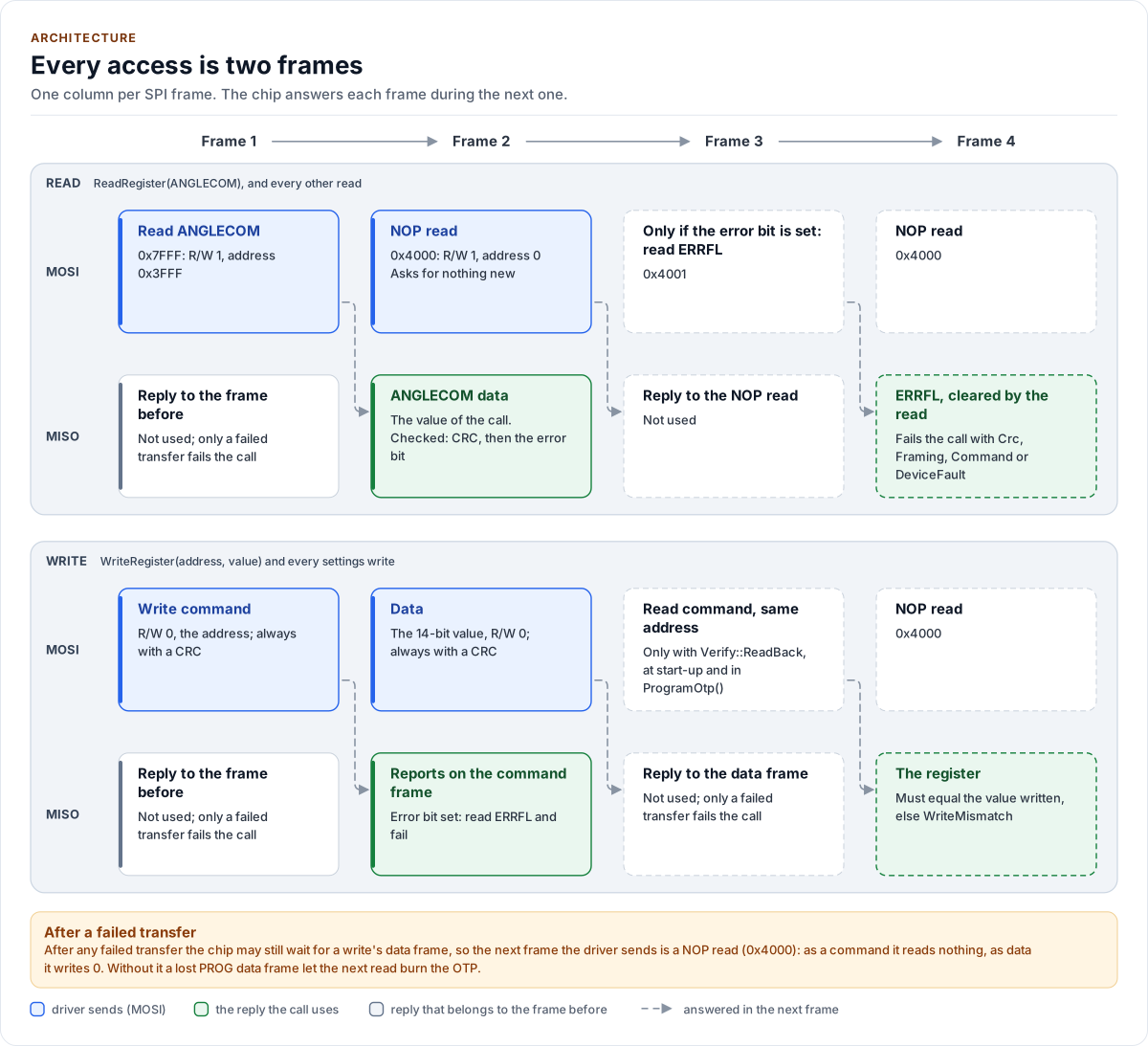
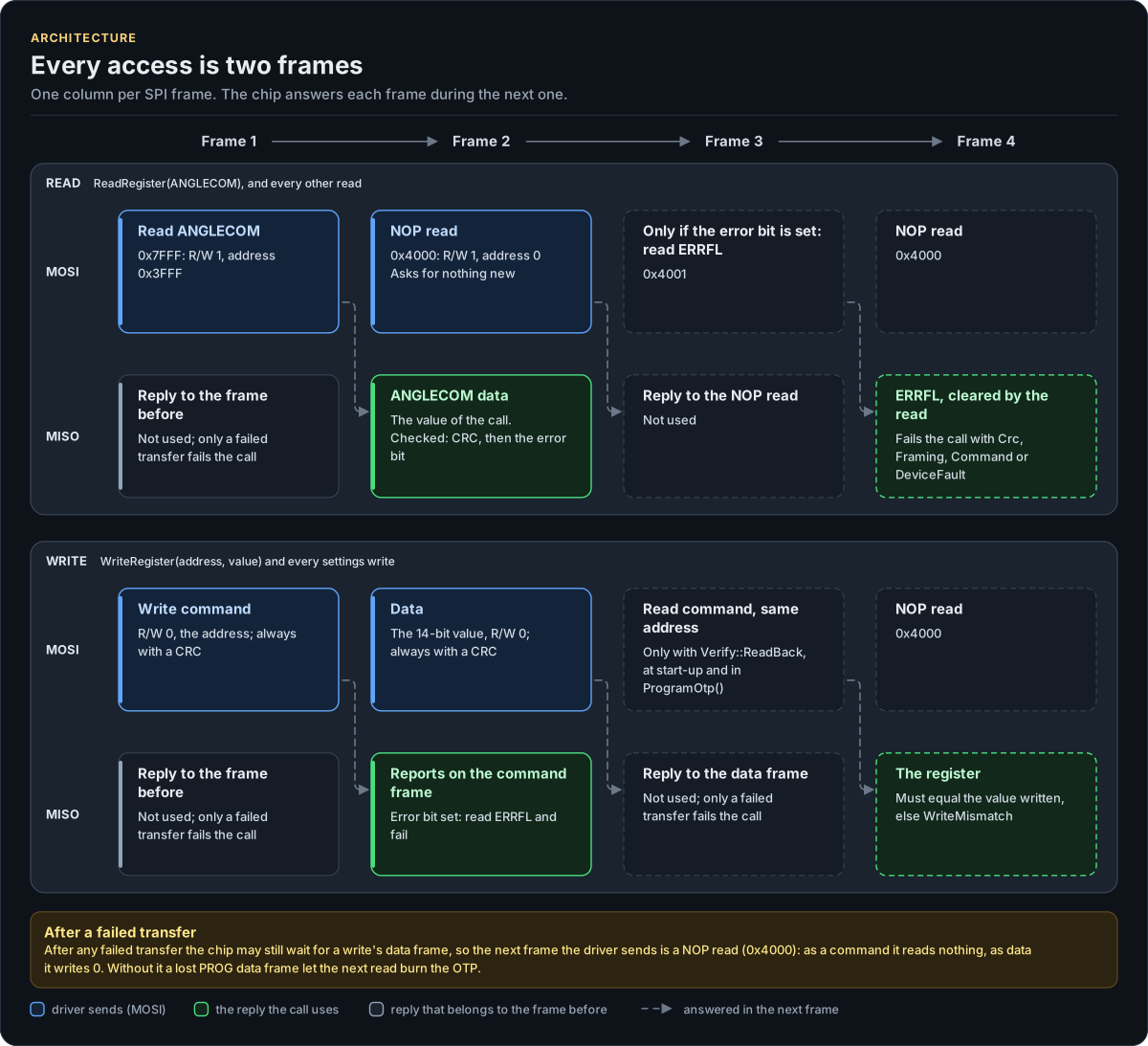
Figure description and sources
Time runs left to right, one column per SPI frame; the top row is what the driver sends on MOSI and the bottom row what the chip returns on MISO in the same frame. The chip answers a frame during the next one (dashed arrows), so a read sends the read command and then a NOP read, whose reply carries the register. The reply in the first frame belongs to the frame before it, so the driver fails the call there only when the transfer itself fails. When the reply that answers the call has its error bit set, the driver reads ERRFL (two more frames, dashed) to find out why and fails the call. A write sends the command frame (R/W at 0, the address) and the data frame, always with a CRC; the reply in the data frame reports on the command frame. The read-back after it (two more frames, dashed) is chosen per call with Verify::ReadBack; EnsureInitialized() and ProgramOtp() always read back. The frame words come from readRaw(), writeRaw() and resolveFlags() in src/as5047u.ipp. A note at the bottom gives the rule of FrameBus::Exchange(): after a failed transfer the next frame is a NOP read, so a lost data frame cannot turn the next command into data.
Drawn from: src/as5047u.ipp readRaw; src/as5047u.ipp writeRaw; src/as5047u.ipp resolveFlags; inc/as5047u.hpp detail::ClassifyErrorFlags; inc/as5047u_registers.hpp frame bits; inc/as5047u_spi_interface.hpp FrameBus::Exchange; figure module docs/diagrams/figures/read-pipeline.py.
Design choices
- CRTP, not virtual functions. The port is a template parameter constrained by the
SpiPortconcept, so every call is resolved at compile time and a missing hook is a compile error that names it. - Exact port concepts.
SpiPortmatches each hook's address withdetail::ExactHook<Port, Sig>, which takes a member function of exactly thatnoexceptsignature and converts no value: a narrowed length or a throwing hook is a compile error, not a silent truncation. - Hooks by named concepts.
DelayUsandLogare detected byDeclares*/Has*concepts in one place. A missingDelayUs()fails to compile atEnsureInitialized(), a missingLog()logs nothing, a misdeclared one is a compile error; none is skipped silently. - The frame layer belongs to the driver. The port moves bytes; the driver builds every frame, computes and checks the CRC and sends writes as CRC-protected frames whatever the read format.
- A flagged reply is resolved, never ignored. The reply's error bit fails the call after ERRFL says why. Its
warning bit refuses an angle or a velocity when ERRFL holds a field warning (
MagnetWarning): a reading the chip says is under an out-of-range field is not a measurement. Every ERRFL value read goes into a latch, so no internal read hides a flag. - Ready means confirmed. Start-up waits for DIA to report every loop finished, twice in a row, with a deadline
from
Config; a stuck or looped-back line cannot fake it. - A lean angle read. Two frames and one test of the flag bits; a flagged reply costs two more. Verification
that adds frames (
Verify::ReadBack) is chosen per call and never applies to reads. - CRC by table.
Crc8()uses a 256-byteconstexprtable, two lookups per word instead of 16 shift-and-XOR steps, checked against the bitwise definition at compile time and for all 65 536 words in a test. On the host the CRC is about three times faster per word (14 ns against 40 to 65 ns on a 64-bit host at-O2), and a 24-bit angle read with a stub port went from 13 to 70 ns to 6 to 16 ns across GCC 15 and Clang; a 16-bit read, which has no CRC, stays within a few nanoseconds of before. Either way the bus dominates: two 24-bit frames take 4.8 µs at 10 MHz. On a target the table costs 256 bytes of flash (read-only data); not measured on an MCU yet. - No I/O in the constructor. Construction cannot fail, so the driver can be a static or a member of a handler.
- One error type.
Result<T>carries a value and anError; nothing throws and nothing returns a barebool. - No heap, no exceptions, no RTTI, no
std::function, noprintf. The driver is a header-only template with no mutable static state.
Source map
| You want | Read |
|---|---|
| The public API | inc/as5047u.hpp |
| How a call is implemented | src/as5047u.ipp |
| Register addresses and bits | inc/as5047u_registers.hpp |
| The port contract | inc/as5047u_spi_interface.hpp |
Next: Contract.