Architecture
How the driver is built: three layers, one of them yours, and what happens in each when you change a setting.
Datasheet sections this page relies on
From NXP Semiconductors PF1550 7:
- I2C address, clock and register framing: 9.7 Control interface I2C block description, p. 71
- I2C operation: single-register transfers: 9.7.2 I2C operation, p. 72
- State machine and transitions: 10 PF1550 state machine, p. 72
- Register map and access types: 12 Register map, p. 80
All of them, with the driver API for each: Datasheet map.
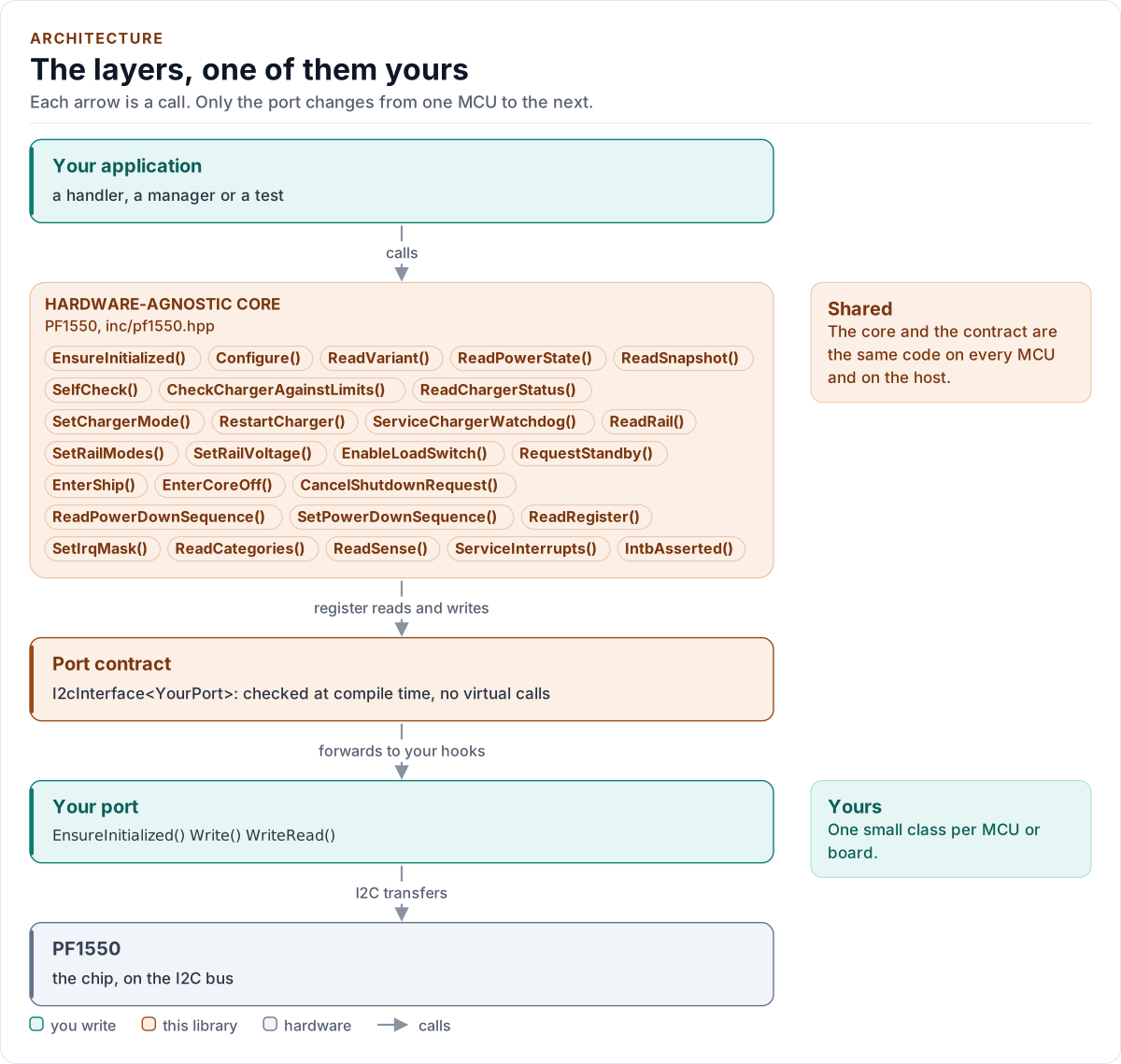
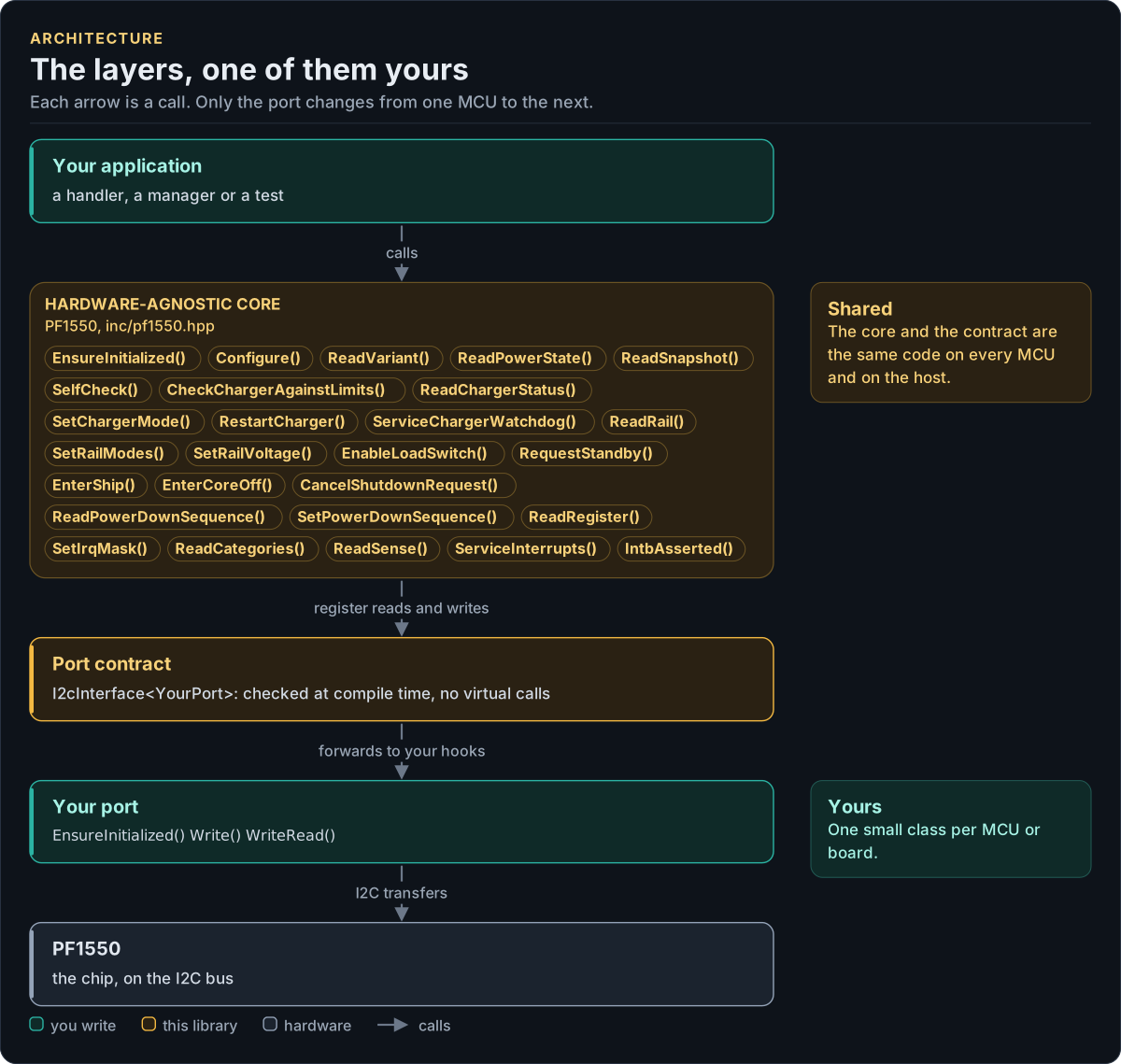
Figure description and sources
Top to bottom, each arrow is a call. Your application calls one object, whose public calls are listed from the umbrella header in inc/. The core turns each call into register reads and writes and hands them to the port contract (the CRTP base in inc/*_interface.hpp), which forwards them, at compile time, to the hooks of the port class you write; your port moves the bytes on the bus. The notes on the right say which layers stay the same on every MCU and which one you write. A library without a port contract has only the first two layers.
Drawn from: inc/pf1550.hpp public calls; inc/pf1550_i2c_interface.hpp I2cInterface; figure module docs/diagrams/figures/driver-layers.py.
Layers
| Layer | Files | Owns |
|---|---|---|
| Core | inc/pf1550.hpp, src/pf1550.ipp |
Lifecycle, the typed calls, the guards, the read-back, the bounded waits, errors |
| Configuration | inc/pf1550_config.hpp, inc/pf1550_codec.hpp |
Limits, Acknowledgements, every block of Config, Validate(); the datasheet grids as constexpr codecs |
| Plans | inc/pf1550_plan.hpp |
A block turned into a list of {register, mask, value} writes, as pure constexpr functions |
| Types and registers | inc/pf1550_types.hpp, inc/pf1550_registers.hpp |
Error, Result<T>, the enumerations; the register map with each register's access type |
| Interrupts | inc/pf1550_irq.hpp |
The 31 sources: where each lives, the categories, fault classification |
| Sequencer | inc/pf1550_sequencer.hpp |
The start-up options of Table 85 and the power-up and power-down timing, as constexpr data |
| Port contract | inc/pf1550_i2c_interface.hpp |
The CRTP base, CtrlPin, GpioSignal, I2cFailure, the I2cPort concept, the register framing |
| Platform port | Your class | Bus bring-up and byte transfers, the delay, optionally STANDBY, INTB, the failure report and logging |
| Kconfig layer | inc/pf1550_kconfig.hpp |
Optional: the limits from ESP-IDF menuconfig |
One call through the layers
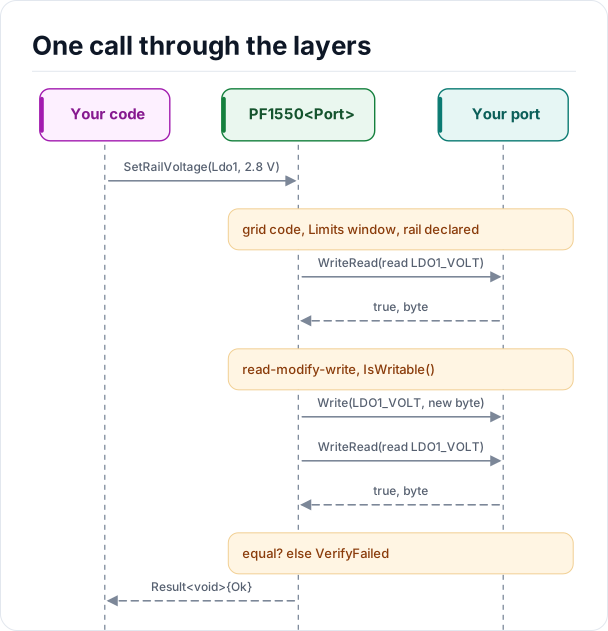
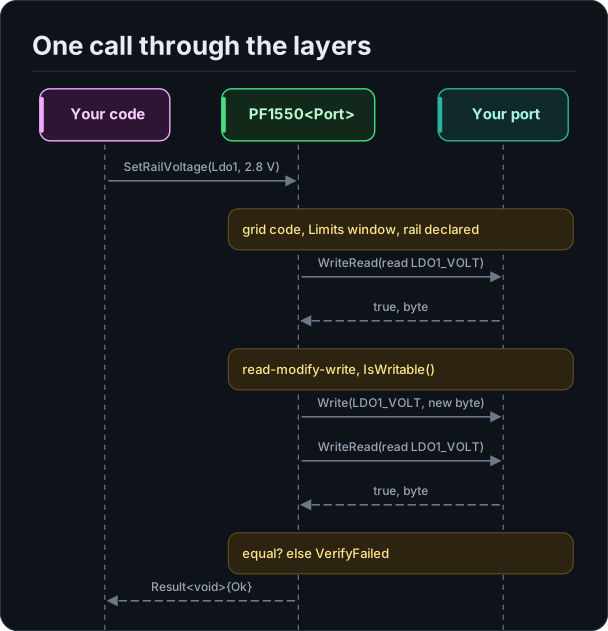
Figure description and sources
Participants, left to right: Your code, PF1550
Drawn from: docs/model/one-call-through-the-layers.seq.yml.
A write is always a read, a masked change, a write and a read. Configure() is the same, applied to the plan of each
block, with the charger last: a plan is a short list of {register, mask, value} entries that a test can check
without a bus.
Design choices
- No raw write. A byte reaches the chip only through one private function that refuses a register the datasheet does not document as writable. The public API is typed: enumerations, grids and codecs, so a value is on the datasheet's table before it becomes a register field.
- Limits first. The application states what its cell, supply and loads tolerate; the driver refuses what exceeds it
(
OutOfLimits) and what lowers a protection without an acknowledgement (Unsafe). - Plans, not branches. Each block is a pure function to a list of writes. The code that applies them is one loop, so the guards and the read-back are in one place and the complexity stays low.
- Charger parked. The charger is set to "linear only" before its parameters change and its mode is written last, because the datasheet does not say whether a parameter change is glitch-free (ambiguities C16 and C49).
- CRTP, not virtual functions. The port is a template parameter constrained by the
I2cPortconcept, so every call is resolved at compile time and a missing hook is a compile error that names it. - Optional hooks by named concepts.
GpioSet,GpioGet,GetLastFailureandLogare detected with C++20 concepts in one place. A hook that is declared with the wrong signature is a compile error; one that is absent changes the call's result (Unsupported), never silently skips a step.DelayUs()is required. - No I/O in the constructor. Construction cannot fail, so the driver can be a static or a member of a handler.
- One error type.
Result<T>carries a value and anError; nothing throws and nothing returns a barebool. - No heap, no exceptions, no RTTI, no
std::function, noprintf. The driver is a header-only template with no mutable static state.
Source map
| You want | Read |
|---|---|
| The public API | inc/pf1550.hpp |
| How a call is implemented | src/pf1550.ipp |
| The configuration and its checks | inc/pf1550_config.hpp |
| Register addresses, bits and access types | inc/pf1550_registers.hpp |
| The sequencer model | inc/pf1550_sequencer.hpp |
| The port contract | inc/pf1550_i2c_interface.hpp |
Next: Contract.