Contract
What the PCAL9555 driver promises, what it needs, and the rules a caller follows.
Datasheet sections this page relies on
From NXP PCAL9555A Rev. 2:
- Power-up value of every register: Table 4 Command byte (power-up default), p. 6
All of them, with the driver API for each: Datasheet map.
The driver inherits the Kokeb Labs driver contract; this page states only what is specific to it. A change to anything here is a breaking change, listed under Breaking in the changelog.
Promises
- The constructor is
noexcept, stores the port, the address and theConfig, does no I/O and cannot fail. EnsureInitialized()is the only start-up call. Its first call validates the storedConfigand the address (no I/O when either is wrong), brings the bus up, checks that a part answers (and, for a PCAL9555A, that the reserved bits of 0x4F read 0), writes the identity pattern 0x55AA to the polarity inversion pair and reads it back, writes every register the driver owns and reads each back. On any failure the driver stays uninitialised and the next call starts again from the beginning. Once it has succeeded it returnsOkat once with no I/O.- Every call that touches the chip returns
Error::NotInitializedbeforeEnsureInitialized()succeeds. No call starts, resets or reconfigures the chip as a side effect. ApplyConfig()before the start only stores the configuration; while running it writes every register and reads each back.- A pin call makes only the transfers the data sheet needs; any read-back is opt-in, per call. Two checks are not
opt-in, because the chip loses state on its own:
SetDirection(),ApplyConfig(),CheckForReset()and a setter about to rewrite the register the reset check reads first read that register (DeviceResetwhen it holds its power-up value, section 6.4), andSetDirection()writes 0x4F (PCAL9555A) and the output pair before the configuration pair (section 6.2.12). On a PCAL9555A with an unmasked input,ReadInputs()andReadPin()read the interrupt status pair before the inputs clear it (sections 6.2.11, 6.5). WithVerify::ReadBackas its last argument (Verify::Noneby default), a setter reads its write back, and a register that did not keep its value returnsError::WriteMismatch: the call then never reports success for a write the chip acknowledged but lost.GetConfig()then holds what was asked for, so repeating an absolute call resends it (afterToggleOutputs(), resend withWriteOutputs(GetConfig().output_high_mask));ReadOutputLatch(),ReadInputMask()andReadPolarityInversion()read what the chip holds.EnsureInitialized()andApplyConfig()always read every register back. - Every port failure propagates, as
Error::NoDevicewhen the port's optionalGetLastFailure()reports an address NACK and asError::Busotherwise; no call returns a stale or zero value after a failed read. AfterWriteMismatchthe copy holds what was asked for, for each register pair that was sent. After a write that failed withBus(its bytes may have arrived) the copy holds the riskier of the old and the asked value (an output rather than an input, the written level, the stronger drive, push-pull; the written value elsewhere) and the register is unknown: no call builds on it before reading it from the chip, and the reset check never reads it. A read of it at its power-up value isDeviceReset(falsely, once, when the failed write's old or new value was the power-up value;EnsureInitialized()recovers); any other value is adopted. AfterNoDevice(an address NACK: nothing arrived) the copy is unchanged. After a failedApplyConfig()the registers written before the failure hold the new values, the one that failed is unknown, and the rest keep the old ones. ReadRegister()is one read with no retry.GetLastInputs(),GetLastOutput(),GetLatchedInterrupts()andClearLatchedInterrupts()do no I/O. Every interrupt status read is ORed into the latch, which onlyClearLatchedInterrupts()empties.- No transfer is empty: every one starts with the command byte, and the driver sends only command bytes the configured part implements.
- Every call is a bounded number of transfers (at most 24, the PCAL9555A start-up); the driver never waits or polls.
Config{}equals the power-up value of every register (PCAL9555A data sheet table 4).- On a driver configured for the PCA9555 (
Variant::Pca9555), every Agile I/O call returnsUnsupportedand sends nothing, andValidate()refuses an Agile I/O field that differs from its power-up value. - A missing
Log()logs nothing; a missingGetLastFailure()makes every failed transferBus. A port that does not satisfyI2cPort(exact hook types,noexcept,bool), or an optional hook declared with another signature, is a compile error. Deinitialize()makes every pin a high-impedance input, the power-up direction: the chip drives nothing.
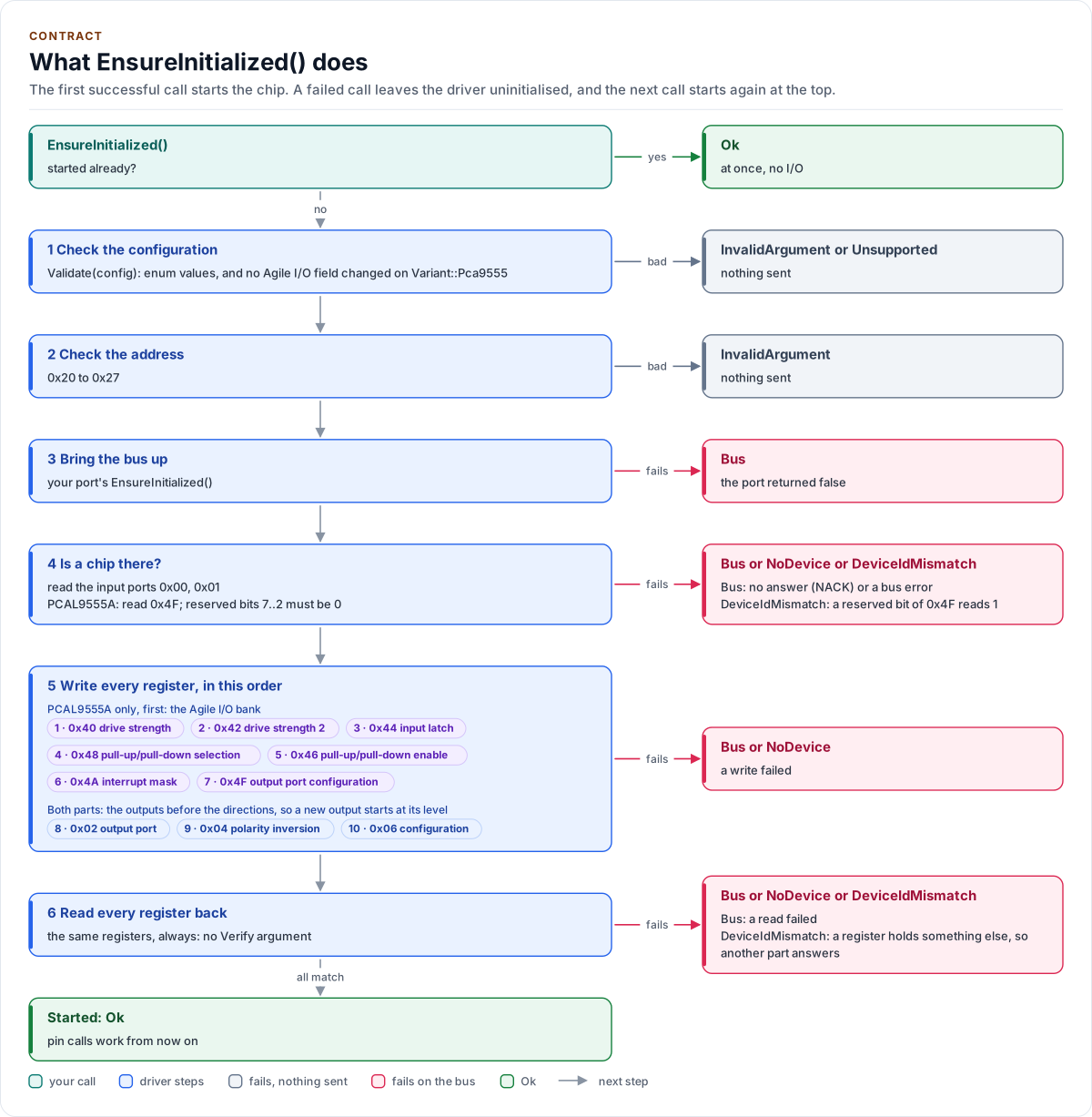
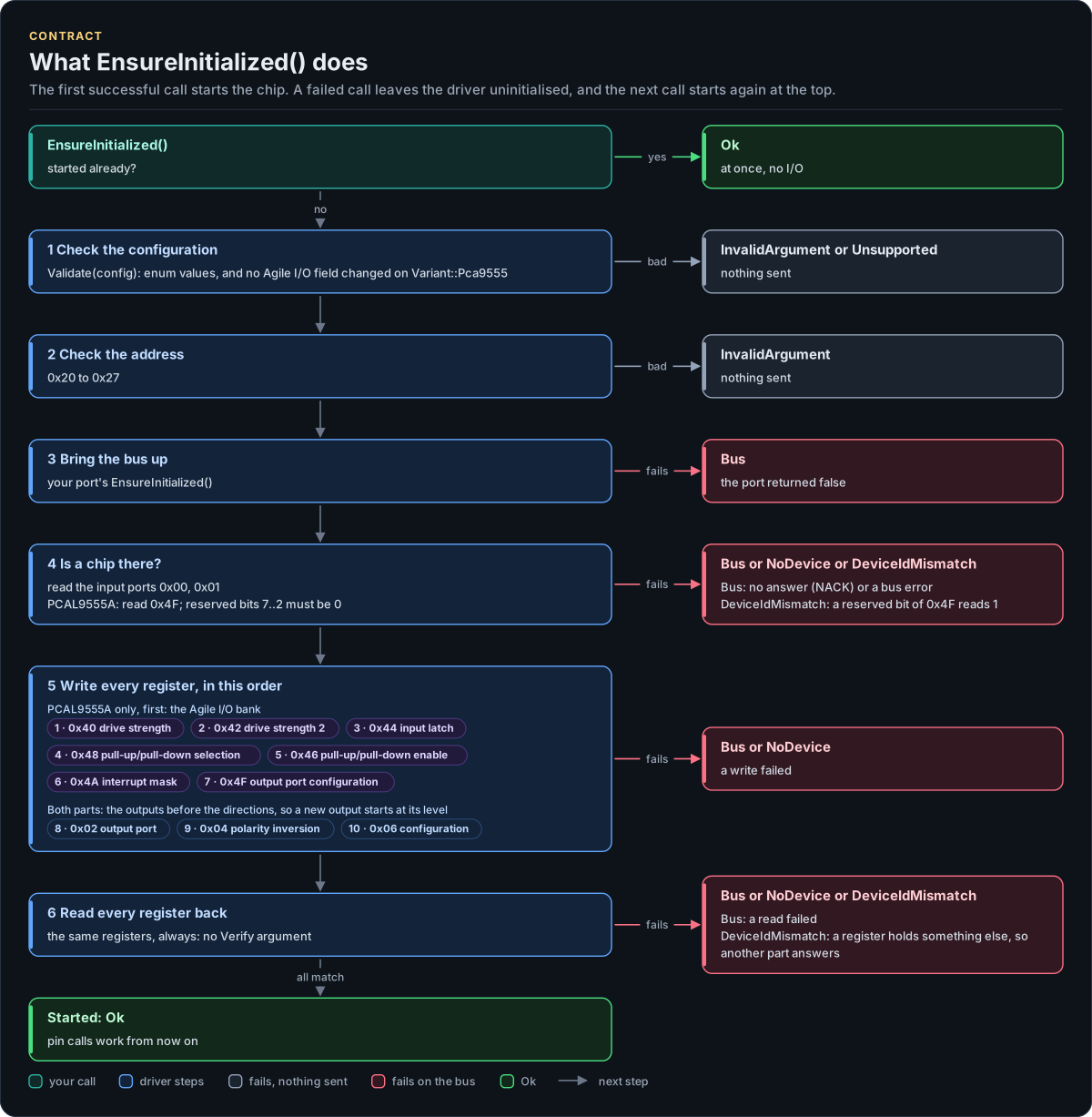
Figure description and sources
Top to bottom on the left, the steps of the first EnsureInitialized() call; once it has succeeded, the call returns Ok at once with no I/O. The configuration and the address are checked before any I/O. Then the port brings the bus up, and the presence check reads the input ports; on a PCAL9555A it also reads 0x4F, whose reserved bits must be 0. Every register the driver owns is then written, in the order the code uses: on a PCAL9555A the Agile I/O bank first and 0x4F after it, then the output values before the directions, so a new output starts at its configured level. Every register is read back, unconditionally; a register that does not hold what was written means another part answers. Each card on the right is the error a step returns. After any failure the driver stays uninitialised and the next call starts again at the top.
Drawn from: src/pcal9555.ipp EnsureInitialized, initialize, checkPresence, writeAll, verifyAll; inc/pcal9555.hpp StandardPairs, AgilePairs; inc/pcal9555_types.hpp Validate, kMinI2cAddress, kMaxI2cAddress; inc/pcal9555_registers.hpp register constants; figure module docs/diagrams/figures/start-up.py.
Depends on
| Dependency | Version | Why |
|---|---|---|
| A C++20 compiler | GCC 10, Clang 13 or later | Concepts constrain the port |
| CMake | 3.16 or later | Generates pcal9555_version.h |
| Your port | The I2C bus and optionally logging (Porting) |
Nothing else: no RTOS, no SDK, no other repository of the org.
Threading
The driver is not thread-safe and takes no lock. Use each driver object from one task at a time, or guard every call on it with one mutex; the layer that owns the driver owns that lock, and the bus lock when several chips share a bus. Nothing may run in an ISR: every call blocks for a bus transfer. When INT falls, signal a task and let it call the driver. Separate objects share no state.
Errors
pcal9555::Error inside pcal9555::Result<T>. Values 0 to 9 are the shared base set. The chip has no timed
operation, CRC, busy state or fault flag, so four base values are never returned. The chip-specific values
report a lost write (WriteMismatch), an absent chip (NoDevice) and a power-on reset (DeviceReset).
Error |
Value | Returned when |
|---|---|---|
Ok |
0 | The call succeeded |
NotInitialized |
1 | EnsureInitialized() has not succeeded, or Deinitialize() ran since, or a call returned DeviceReset |
InvalidArgument |
2 | A Config field or argument is not an enumerator, a mask is 0, a pin is above 15, the address is outside 0x20 to 0x27, or ApplyConfig() changes the variant of a running driver; nothing was sent |
Bus |
3 | A port hook returned false and the port did not report an address NACK: a bus error, a command byte the part refuses, or (with a port without GetLastFailure()) no chip at the address |
Timeout |
4 | Not returned by this driver |
DeviceIdMismatch |
5 | At start-up: a register read back differently from what EnsureInitialized() wrote, or a reserved bit of 0x4F read 1 on a PCAL9555A: another part answers at the address |
Crc |
6 | Not returned by this driver |
Busy |
7 | Not returned by this driver |
DeviceFault |
8 | Not returned by this driver |
Unsupported |
9 | An Agile I/O call, or an Agile I/O Config field, on a driver configured for the PCA9555 |
WriteMismatch |
16 | After the start, a register read back differently from what a setter or ApplyConfig() just wrote: the chip acknowledged the write and lost it (setters only with Verify::ReadBack) |
NoDevice |
17 | Any call that makes a transfer, when the port's GetLastFailure() reports that nothing acknowledged the address: no chip, or an unpowered one |
DeviceReset |
18 | CheckForReset(), SetDirection(), ApplyConfig(), or a setter about to rewrite the register the reset check reads, found that register at its power-up value while the copy says otherwise: a power-on reset (or a dropped write to it). Nothing was written; the driver is uninitialised |
The API guide says what to do about each.
Memory
No heap, no exceptions, no RTTI, no std::function, no std::string, no printf and no static mutable state. A
driver object holds a reference to the port, the address, a Config (the copy of the registers), the last
input and output values read, the interrupt latch, the set of registers whose last write failed, and a flag:
56 bytes on a 64-bit host, less on a 32-bit MCU.
The largest stack buffer is 3 bytes (a register pair and its command byte).
Platform
Platform-free: the same code runs on any target with a C++20 compiler, including the host tests. The ESP-IDF port
in examples/esp32 is an example, not part of the driver.
Deviations from the standard
| Rule (standards/driver.md) | Here | Why |
|---|---|---|
| Start-up resets the chip (hardware reset if a pin hook exists, else software reset) | No reset: every register the driver owns is written instead | Neither part has a reset pin or a software reset; writing every register gives the same known state, whatever a previous run left |
| A setter updates the driver's copy only after the chip accepted the change (KB-CPP-120) | After a write that failed with Bus, the copy holds the riskier of the old and the asked value, marked unknown, and is read from the chip before anything is built on it |
A failed transfer can still have delivered its bytes (a NACK or a lost ACK after them), so the old value is no safer a guess than the new one; the riskier one (an output, the written level, the stronger drive, push-pull) never understates what the pins may be doing, and the read before reuse means no write is computed from either guess |
| Start-up reads and checks the chip ID before applying the configuration | Presence by reading the input ports; identity by writing a test pattern to the polarity inversion pair and reading it back, then reading every written register back (and the reserved bits of 0x4F on a PCAL9555A) | The parts have no ID register; the input ports hold pin levels, and the other registers' power-up values are lost after a warm start, so only a read-back of known values identifies the part. The pattern goes to the one pair that changes no pin, so nothing is driven before the identity is confirmed |