API guide
The driver's API by task, with code that compiles: start, drive outputs, read inputs, handle an interrupt, stop and handle errors. The PCAL9555A extras have their own page, Agile I/O.
Datasheet sections this page relies on
- Input, output, polarity inversion and configuration registers: NXP PCAL9555A Rev. 2, 6.2.2 to 6.2.5 Input port, Output port, Polarity inversion and Configuration register pairs, p. 7
- Interrupt status: NXP PCAL9555A Rev. 2, 6.2.11 Interrupt status register pair, p. 12
- Power-on reset: NXP PCAL9555A Rev. 2, 6.4 Power-on reset; 8.3 Power-on reset requirements, p. 13
- Interrupt output (INT): NXP PCAL9555A Rev. 2, 6.5 Interrupt output, p. 14
- Power-on reset: NXP PCA9555 Rev. 10, 6.3 Power-on reset, p. 8
- Interrupt output (INT), no mask or status: NXP PCA9555 Rev. 10, 6.5.3 Interrupt output, p. 14
All of them, with the driver API for each: Datasheet map.
The shape of the API
| Group | Calls |
|---|---|
| Lifecycle | EnsureInitialized(), IsInitialized(), Deinitialize() |
| Configuration | ApplyConfig(), GetConfig(), GetAddress() |
| Pins (both parts) | SetDirection(), SetOutputs(), WriteOutputs(), ToggleOutputs(), SetPolarityInversion(), ReadInputs(), ReadPin() |
| Agile I/O (PCAL9555A) | SetDriveStrength(), SetPull(), SetInputLatch(), SetInterruptEnabled(), ReadInterruptStatus(), SetOutputMode() |
| Free functions | Validate(), PinMask(), AddressFromPins(), DriveStrengthAll(), ToString(), GetDriverVersion() |
Every call that touches the chip returns Result<T>: check ok() (or the bool conversion) and read value, or
read error. Result is [[nodiscard]], so an unchecked call is a compiler warning. A failed call's value is
T{}, never a stale or partial reading.
Pins are numbered 0 to 15: 0 to 7 are P0_0 to P0_7, 8 to 15 are P1_0 to P1_7. The calls that change pins take a
mask, bit n for pin n (PinMask(n)), and change only the pins in it; a mask of 0 is InvalidArgument.
Start
constexpr pcal9555::Config Agile() {
  pcal9555::Config c{};
  c.variant = pcal9555::Variant::Pcal9555a;
  return c;
}

pcal9555::Error BringUp(Expander& io) {
  // Expander io(port, 0x20, Agile()); stores the configuration, no I/O.
  const auto r = io.EnsureInitialized(); // first call starts the chip; then Ok, no I/O
  if (!r) {
    std::printf("PCAL9555A start: %s\n", pcal9555::ToString(r.error)); // the next call retries
  }
  return r.error;
}
The constructor stores the port, the address and the configuration and does no I/O. EnsureInitialized() is the
one way to start the chip. Its first call checks the configuration (Validate()) and the address, brings the bus
up, reads the input ports to see that a part ACKs, on a PCAL9555A reads 0x4F and checks that its reserved bits are
0, then writes every register of the configuration and reads each back. A register that does not hold what was
written means another part answers at the address: DeviceIdMismatch.
Once it has succeeded, EnsureInitialized() returns Ok at once with no I/O, so a caller (or a handler that owns
the driver) can call it before every use. After a failure the driver stays uninitialised and the next call starts
again from the beginning. No other call starts the chip: before EnsureInitialized() succeeds every read and write
returns NotInitialized and sends nothing. ApplyConfig() before the start only stores the configuration for the
first EnsureInitialized().
The chip has no reset, so the start-up writes every register instead: the result is the same whatever the chip held before, a power-up or a previous run of the firmware.
Drive outputs
pcal9555::Error DriveRelays(Expander& io) {
  constexpr uint16_t kRelays = 0x000F;              // P0_0..P0_3
  if (auto r = io.SetOutputs(kRelays, false); !r) { // level first: off
    return r.error;
  }
  if (auto r = io.SetDirection(kRelays, pcal9555::Direction::Output); !r) {
    return r.error;
  }
  return io.ToggleOutputs(pcal9555::PinMask(2)).error; // relay 2 on, one write
}
| Call | Register pair | Effect |
|---|---|---|
SetOutputs(mask, high) |
Output port | Pins in mask high or low |
WriteOutputs(high_mask) |
Output port | All 16 at once |
ToggleOutputs(mask) |
Output port | Pins in mask inverted |
SetDirection(mask, Direction::Output) |
0x4F, output port, configuration | Pins in mask drive their output value |
Set the level before the direction: a pin that becomes an output drives its output latch at once, and the latch is high after power-up. The output latch is kept for input pins, so it can be prepared while the pin is still an input.
SetDirection() is the one pin call that sends more than its own register. A pin that becomes an output drives its
latch through its port's output stage, and a power-on reset sets every latch high and every stage push-pull (table
4). So it first checks for a reset (one read, see Recover after a power loss), then
writes from the driver's copy in the data sheet's order (section 6.2.12): 0x4F on a PCAL9555A, the output pair, the
configuration pair. Whatever the chip went through, no pin becomes an output at a level or stage you did not set.
It costs one read and two write pairs on a PCA9555, plus a 1-byte write on a PCAL9555A (about 0.3 ms at 400 kHz
instead of 90 µs); call it at configuration time, not in a fast loop.
Releasing pins (Direction::Input) is the safe direction, and the cheapest. When every pin ends up an input,
the configuration pair is the only transfer: no check, nothing before it that could fail, since nothing can be
driven whatever the chip went through. When other pins stay outputs, the reset check comes first, then the
configuration pair, so the pins are released by the first write, then 0x4F and the output pair for the remaining
outputs.
The driver keeps a copy of every register it wrote (GetConfig()), computes the new pair from it and writes the
pair in one transfer, without reading it first: by default a pin call other than SetDirection() is the one 3-byte
write the data sheet needs and nothing more. Read-back is chosen per call: every setter takes a last argument
Verify, Verify::None by default. With Verify::ReadBack the call then reads the pair back, a 2-byte read that
more than doubles its bus time, and a write the chip acknowledged but did not keep returns Error::WriteMismatch.
An acknowledge carries no checksum, and the data sheet allows for a glitch or data corruption (section 8.3); the
output port reads back the value it holds, not the pin (section 6.2.3), so the read-back shows what the chip will
drive. Pass Verify::ReadBack on the calls where a lost write matters more than the bus time, such as a driver
enable, and leave the hot path at the default.
A write whose transfer failed (Bus, NoDevice) may still have reached the chip: the bytes can be stored before a
lost ACK or a NACK of the last byte. So after a failed write the copy does not keep the old value as if nothing
happened. It takes the riskier of the old and the asked value, and the register is marked unknown:
| Register pair | The copy after a failed write |
|---|---|
Configuration (input_mask) |
A pin that was or was asked to be an output counts as an output (old AND asked) |
Output port (output_high_mask) |
The written level |
Drive strength (drive_strength_codes) |
The stronger code of each pin |
0x4F (port0_mode, port1_mode) |
Push-pull if either was push-pull |
| Polarity, input latch, pull enable and selection, interrupt mask | The written value |
The next call that builds on an unknown register first reads it from the chip into the copy (one more read, only
after a failure), so it never computes a new value from a stale one; a successful write of the pair, a read-back
call (ReadOutputLatch(), ReadInputMask(), ReadPolarityInversion()), ApplyConfig() and EnsureInitialized()
make it known again. An unknown register read back at its power-up value is taken as a reset, DeviceReset; any
other value is adopted. When the failed write's old or new value was itself the power-up value, that is a false
DeviceReset: one time, nothing written, and EnsureInitialized() recovers. After a failed ApplyConfig()
the registers written before the failure hold the new values, the one that failed is unknown, and the rest keep
the old ones.
GetConfig() is the driver's copy, so after a failed write it shows the riskier value for the direction, the
drive strength and 0x4F, and the written level for the outputs: not necessarily what the pins do. Read the chip
with ReadOutputLatch() (and ReadInputMask()) when it matters.
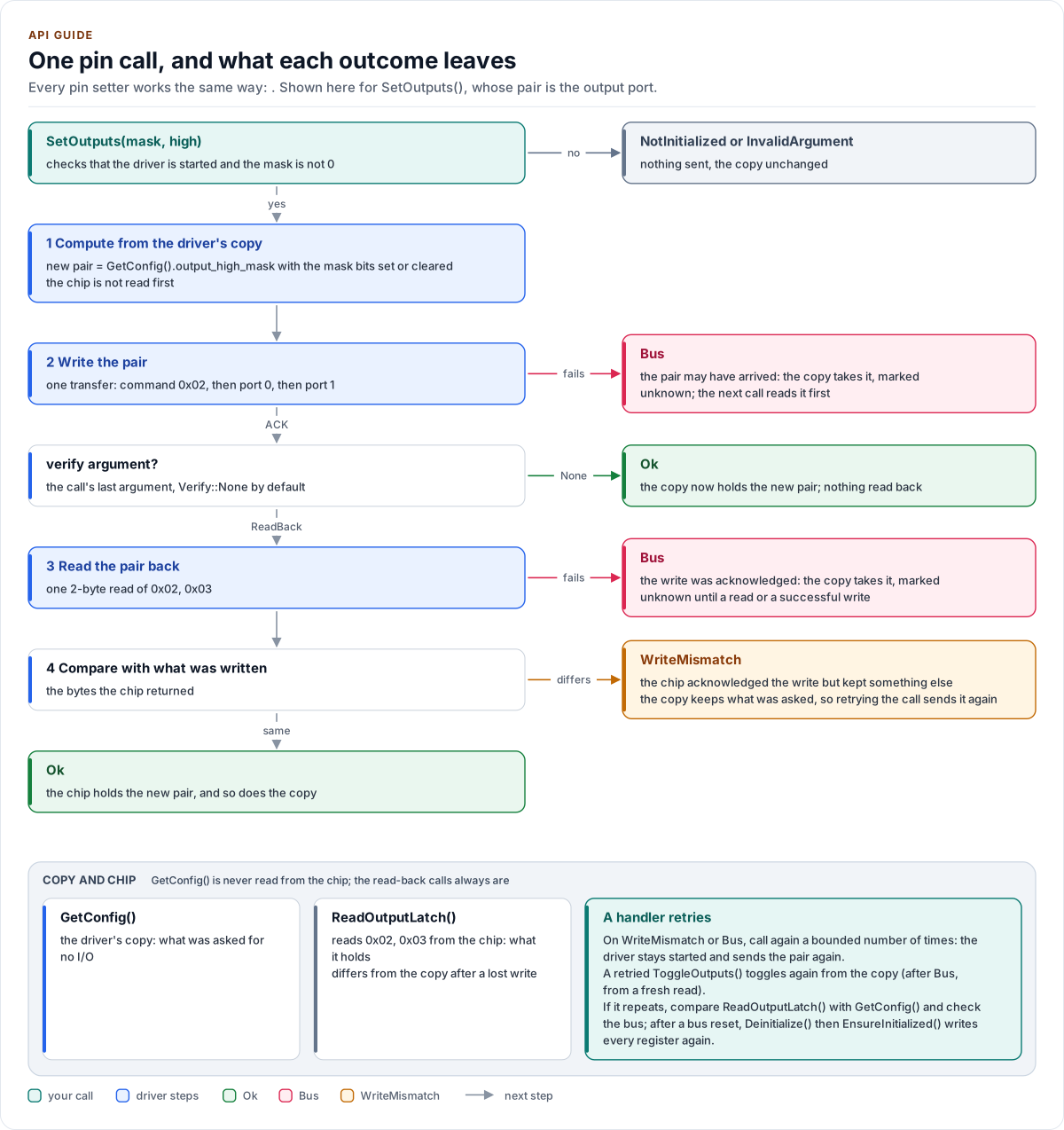
Figure description and sources
Top to bottom on the left, the steps of SetOutputs(); the other pin setters take the same path to their own register pair. The call first checks that the driver is started and the mask is not 0, with no I/O. It computes the new output pair from the driver's copy (GetConfig()) without reading the chip, and writes it in one transfer. With Verify::ReadBack passed (the default is Verify::None) it reads the pair back. The cards on the right are the outcomes: Bus may have delivered the pair, so the copy takes the written level, marked unknown, and the next call reads it before building on it; WriteMismatch means the chip acknowledged the write but holds something else, and the copy keeps what was asked, so retrying the call sends it again; Ok updates the copy. The band at the bottom contrasts the copy with ReadOutputLatch(), which reads the output pair from the chip, and says how a handler retries.
Drawn from: src/pcal9555.ipp SetOutputs, writeMask, storeMask, writePairChecked, ReadOutputLatch; inc/pcal9555_types.hpp Verify; inc/pcal9555_registers.hpp kOutputPort0; figure module docs/diagrams/figures/pin-write.py.
Read back what the chip holds
// Enable a motor driver, retrying a write the chip acknowledged but lost.
pcal9555::Error EnableDriver(Expander& io) {
  constexpr uint16_t kEnable = pcal9555::PinMask(9); // P1_1
  pcal9555::Result<void> r{};
  for (int attempt = 0; attempt < 3; ++attempt) {
    r = io.SetOutputs(kEnable, true, pcal9555::Verify::ReadBack); // write, then read back
    if (r.error != pcal9555::Error::WriteMismatch) {
      break;
    }
  }
  if (!r) {
    return r.error;
  }
  const auto latch = io.ReadOutputLatch(); // what the chip drives, not the driver's copy
  return latch && (latch.value & kEnable) != 0 ? pcal9555::Error::Ok
                                               : pcal9555::Error::WriteMismatch;
}
| Call | Register pair | Returns |
|---|---|---|
ReadOutputLatch() |
Output port | The level each pin is told to drive |
ReadInputMask() |
Configuration | 1 for each input pin |
ReadPolarityInversion() |
Polarity inversion | 1 for each inverted input |
GetConfig() is what the driver asked for; these read the chip. For an output pin, ReadInputs() returns the
level on the pin, which a load or another driver on the line can pull away from the latch: to know what the expander
is driving, read the latch. Each is one 2-byte read, and none changes a register or clears an interrupt.
Read inputs
pcal9555::Result<uint16_t> ReadSwitches(Expander& io) {
  // Active-low switches read as 1 when closed; only input pins are inverted.
  if (auto r = io.SetPolarityInversion(0xFF00, true); !r) {
    return pcal9555::Result<uint16_t>::Failure(r.error);
  }
  const auto in = io.ReadInputs(); // both ports in one transfer; clears INT
  if (!in) {
    return in;
  }
  return pcal9555::Result<uint16_t>::Success(static_cast<uint16_t>(in.value >> 8U));
}
ReadInputs() reads both input ports in one transfer and returns the level of every pin, outputs included, after
polarity inversion. ReadPin(pin) reads only the port of that pin. SetPolarityInversion(mask, true) inverts how
input pins read, for active-low signals. Reading an input port also releases the interrupt of that port.
Reading an input port also clears the chip's interrupt status for that port (sections 6.2.11, 6.5), before anything
else could read it. So on a PCAL9555A with at least one input whose interrupt is unmasked, ReadInputs() and
ReadPin() first read the interrupt status pair into GetLatchedInterrupts(): one more 2-byte read (113 µs at 400
kHz). With every input masked, and on a PCA9555, they stay one read. ReadRegister(0x00) stays a raw read without
it.
Diagnose on the bench
// Bring-up: compare what was asked for, what the chip last reported and what it holds now.
void Diagnose(Expander& io) {
  const uint16_t asked = io.GetConfig().output_high_mask; // the driver's copy, no I/O
  const uint16_t seen = io.GetLastOutput();               // the last output read, no I/O
  const auto oconf = io.ReadRegister(pcal9555::reg::kOutputPortConfig); // one read, no retry
  const uint16_t changed = io.GetLatchedInterrupts(); // every status read since the clear
  io.ClearLatchedInterrupts();
  std::printf("outputs asked 0x%04X, seen 0x%04X; 0x4F %s 0x%02X; changed 0x%04X\n",
              static_cast<unsigned>(asked), static_cast<unsigned>(seen),
              pcal9555::ToString(oconf.error), static_cast<unsigned>(oconf.value),
              static_cast<unsigned>(changed));
}
| Call | I/O | Returns |
|---|---|---|
ReadRegister(command) |
One 1-byte read, no retry | Any register the configured part implements (0x00 to 0x07; on a PCAL9555A also 0x40 to 0x4D and 0x4F); any other command byte is InvalidArgument with nothing sent |
GetLastInputs() |
None | The input ports as the driver last read them: ReadInputs(), ReadPin(), a raw read or the start-up presence check |
GetLastOutput() |
None | The output port registers as the chip last reported them: ReadOutputLatch(), a Verify::ReadBack of an output write, the start-up read-back or a raw read |
GetLatchedInterrupts() |
None | Every pin any interrupt status read reported since ClearLatchedInterrupts(), ORed together |
ClearLatchedInterrupts() |
None | Empties that latch; the chip is not touched |
Reads have the chip's own side effects and no others: a raw read of an input port (0x00, 0x01) clears that port's
interrupt, as ReadInputs() does. Reading the input ports clears the chip's interrupt status too, which is why the
driver keeps every status it read in the latch until you clear it (handbook KB-CPP-119). Keeping the last values
costs two compares per read and no I/O; the hot path is otherwise unchanged.
Handle an interrupt
// Call from a task when INT went low (never from the ISR: every call blocks on the bus).
pcal9555::Result<uint16_t> ServiceInterrupt(Expander& io, uint16_t& levels) {
  const auto source = io.ReadInterruptStatus(); // which pins; does not clear INT
  if (!source) {
    return source;
  }
  const auto in = io.ReadInputs(); // latched levels; clears INT
  if (!in) {
    return pcal9555::Result<uint16_t>::Failure(in.error);
  }
  levels = in.value;
  return source;
}
INT is open-drain, active low. Never call the driver from the ISR: every call blocks on the bus. Let the ISR wake a
task, which then reads. On a PCAL9555A, ReadInterruptStatus() names the pins that raised INT (and does not clear
it; the driver also ORs it into GetLatchedInterrupts()); ReadInputs() then releases it. A status that only an
input read saw is not lost either: with an unmasked input, the input read latches the status first. On a PCA9555
there is no status register: compare ReadInputs() with the last value. Both parts and the input latch are on
Hardware and Agile I/O.
Stop
void Release(Expander& io) {
  if (auto r = io.Deinitialize(); !r) { // every pin back to an input
    std::printf("PCAL9555 release failed: %s\n", pcal9555::ToString(r.error));
  }
  // io.EnsureInitialized() later writes the configuration again, pin changes included.
}
Deinitialize() makes every pin an input, the power-up direction, so the chip drives nothing, and marks the driver
uninitialised. The driver keeps its copy of the registers, pin changes included: the next EnsureInitialized()
writes it all again.
Recover after a power loss
// Once per control period: a supply dip resets the expander without a word (section 6.4).
pcal9555::Result<void> KeepStarted(Expander& io) {
  if (const auto r = io.CheckForReset(); r.error != pcal9555::Error::DeviceReset) {
    return r; // Ok (one read, more only after a failed write), Bus or NoDevice
  }
  return io.EnsureInitialized(); // writes every register again, outputs before directions
}
The chip resets every register when its supply drops below the power-on reset voltage (section 6.4): every pin an
input, every output latch high, both ports push-pull, every interrupt masked (table 4). It has no reset pin and no
reset flag, so the driver looks for the reset in the registers: CheckForReset() reads one register whose copy
differs from its power-up value (the Agile I/O pairs and the polarity pair first, then 0x4F, the configuration pair
and the output pair) and returns Error::DeviceReset when it reads its power-up value. Nothing is written, the
driver is uninitialised, and EnsureInitialized() writes the copy again in the data sheet's order. When every
register of the copy is at its power-up value, nothing is sent: a reset then leaves the chip as the driver believes
it to be.
SetDirection() and ApplyConfig() run the same check first, and so does a setter about to rewrite the register
the check reads, unless that register is the only one off its power-up value (its write then leaves the chip right
after a reset or a lost write alike). Call CheckForReset() where a supply dip is possible: once per control
period, or before an output change that matters. A write to the checked register that the chip acknowledged but
dropped reads the same way; the recovery is the same.
If a call returns Bus or NoDevice, start again too: Deinitialize() (a failing write still leaves the driver
uninitialised), then EnsureInitialized(), which writes every register from the driver's copy. The ESP32 example
does both.
Use it from a handler
On a board, the driver usually sits under a handler that owns it, the port and the bus, and that hands pins to the rest of the firmware. The driver leaves to the handler what it cannot know:
- Start-up. The handler calls
EnsureInitialized()from its own lazy start; the driver never starts itself, so a read before it returnsNotInitializedinstead of doing hidden I/O on a time-critical path. - Retries. The driver never retries. On
WriteMismatchorBusfrom a pin call, retry the call a bounded number of times and count the attempts (handbook KB-ARCH-044); the driver stays started. Every pin call writes a whole register pair from the copy, so repeating it is safe. OnNoDevicedo not retry the call: the chip is gone or unpowered, so recover as below. AfterWriteMismatchthe copy holds what was asked for, so an absolute call (SetOutputs(),WriteOutputs(),SetDirection(), ...) can simply be repeated; a relative one,ToggleOutputs(), cannot (it would toggle back): resend withWriteOutputs(GetConfig().output_high_mask). - Recovery. If the bus needs a reset (clocking SCL free, re-initialising the peripheral), do it in the port or
the handler, then
Deinitialize()andEnsureInitialized(): every register is written again from the copy. - Locks and threads. The driver takes no lock; the handler serialises the calls, and the bus lock belongs in the port.
- Time. Every call is at most 24 transfers and never waits, so its duration is the port's: give the port a short timeout (a few milliseconds at 100 kHz), and keep expander calls off threads with hard deadlines: a long I2C timeout on a time-critical thread stalls it for that long whenever the bus fails.
- The part. Choose
Config::variantfrom the board: a PCAL9555A configured as a PCA9555 works, without the Agile I/O calls; the reverse fails at start-up withDeviceIdMismatch.
Handle errors
const char* Describe(pcal9555::Error e) {
  switch (e) {
  case pcal9555::Error::NoDevice:
    return "nothing acknowledges the address: check the address pins and the supply";
  case pcal9555::Error::Bus:
    return "a transfer failed: check the pull-ups, the bus length and the supply";
  case pcal9555::Error::DeviceIdMismatch:
    return "another part answers at this address, or the variant is wrong";
  case pcal9555::Error::DeviceReset:
    return "the expander reset (supply dip): call EnsureInitialized() again";
  case pcal9555::Error::Unsupported:
    return "an Agile I/O feature on a PCA9555: set Config::variant if a PCAL9555A is fitted";
  default:
    return pcal9555::ToString(e);
  }
}
| Signal | Meaning | What to do |
|---|---|---|
Error::NoDevice |
Nothing acknowledged the address (only with a port that has GetLastFailure()) |
Check the address pins and the supply; Deinitialize(), then EnsureInitialized() |
Error::Bus |
The port failed a transfer or the bus bring-up: a bus error, a refused command byte, or, with a port without GetLastFailure(), also an absent chip |
Check the pull-ups, the bus and the supply (and the address pins); Deinitialize(), then EnsureInitialized() |
Error::DeviceIdMismatch |
At start-up, a register did not read back what was written, or a reserved bit of 0x4F read 1 | Another part at the address, or variant set to Pcal9555a on a PCA9555 |
Error::DeviceReset |
A running driver found a register back at its power-up value: the chip went through a power-on reset (or dropped a write to that register). Nothing was written; the driver is uninitialised | EnsureInitialized(), which writes the copy again in order; if it repeats, check the expander's supply |
Error::WriteMismatch |
After the start, a register did not keep what a call just wrote | Retry the same call (it resends what GetConfig() holds); if it repeats, check the bus (pull-ups, length, noise) and ReadOutputLatch() |
Error::Unsupported |
An Agile I/O call or Config field on a driver configured for the PCA9555 |
Set Config::variant to Pcal9555a if a PCAL9555A is fitted |
Error::InvalidArgument |
A mask of 0, a pin above 15, an address outside 0x20 to 0x27, a value that is not an enumerator, or a changed variant; nothing was sent | Fix the value (Validate()) |
Error::NotInitialized |
EnsureInitialized() has not succeeded, or a call returned DeviceReset |
Call it |
Error::Timeout, Error::Crc, Error::Busy and Error::DeviceFault belong to the shared base set but are never
returned by this driver: the chip has no timed operation, no CRC, no busy state and no fault flag. Every value, with
the calls that return it, is on the Contract page. pcal9555::ToString() names an error for
a log.
Next: Agile I/O.