Architecture
How the driver is built: the core, the free conversion functions, the port contract, and your port.
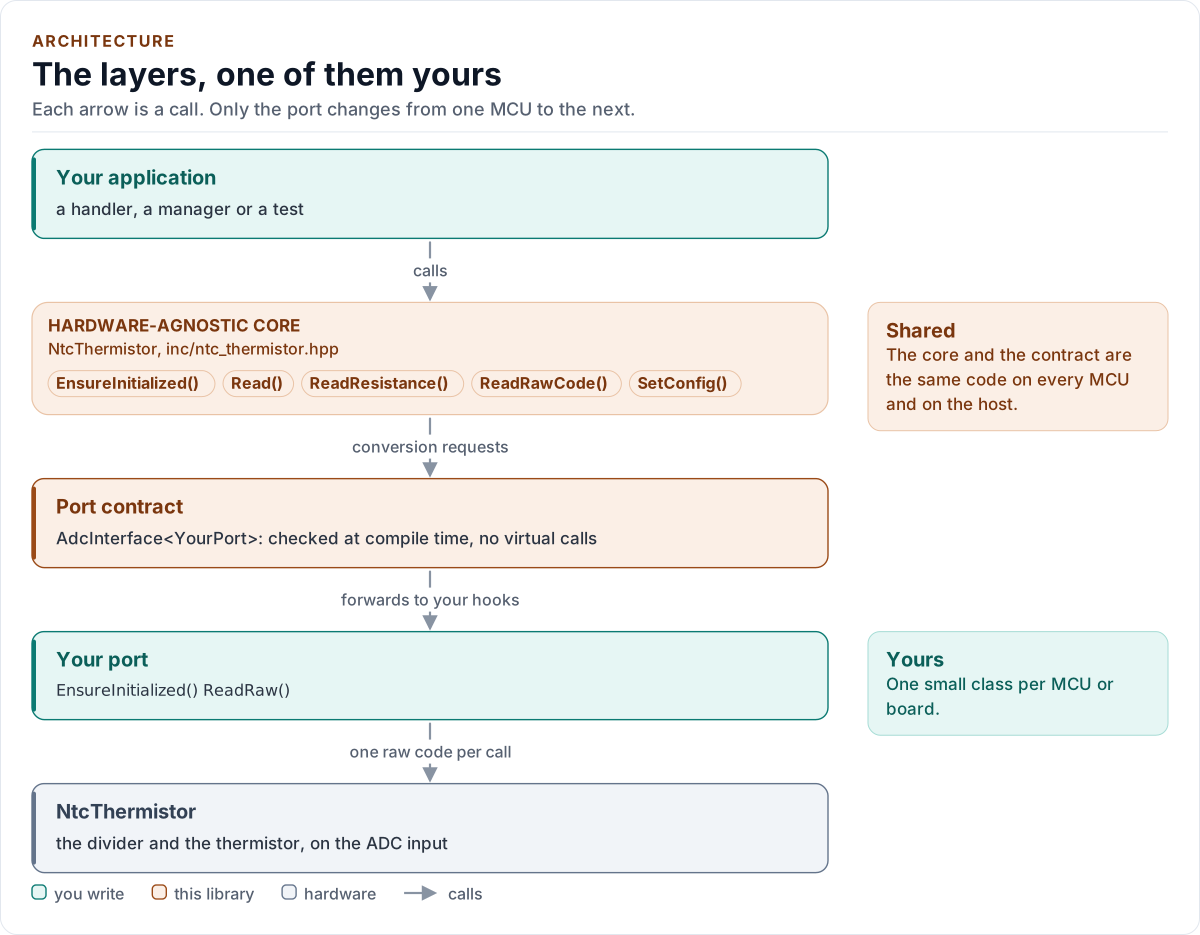
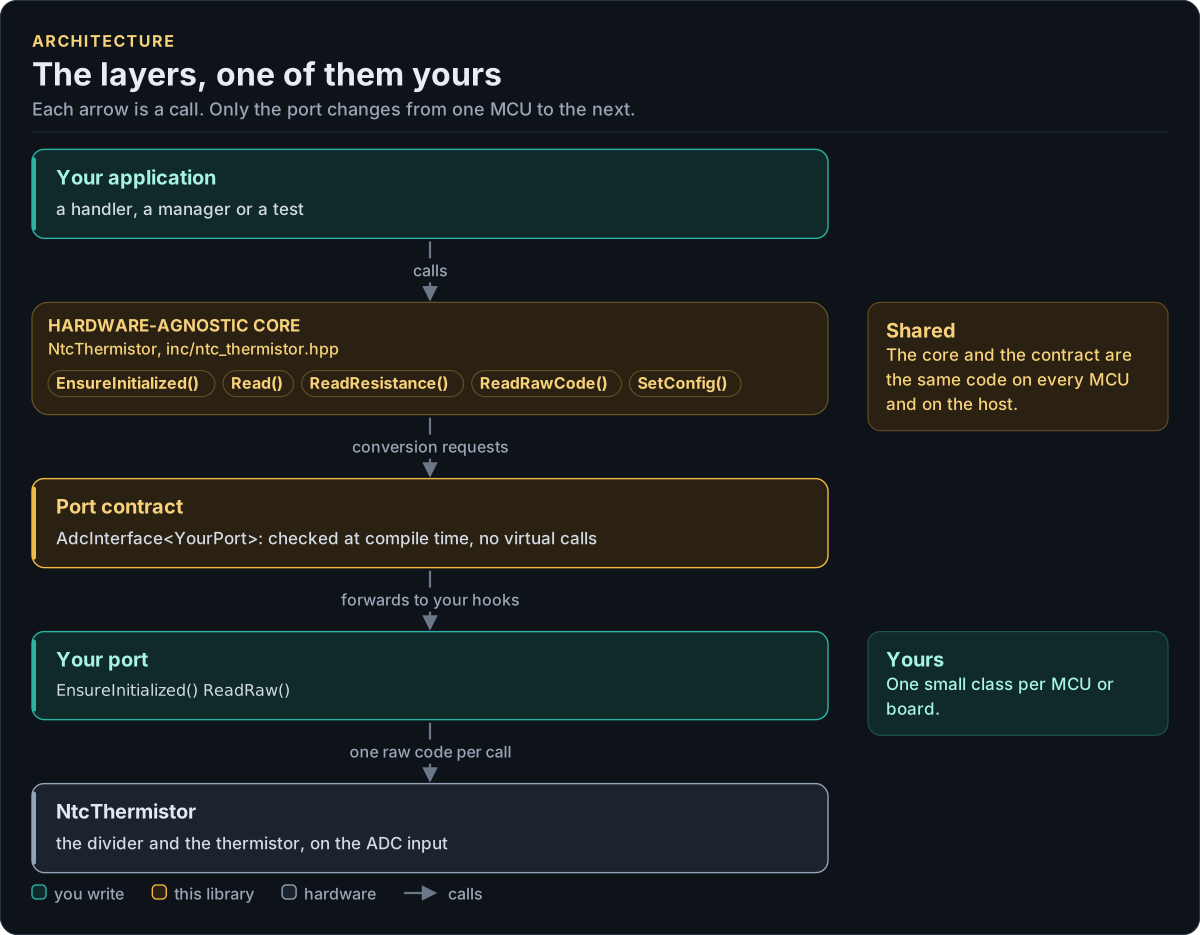
Figure description and sources
Top to bottom, each arrow is a call. Your application calls one object, whose public calls are listed from the umbrella header in inc/. The core turns each call into register reads and writes and hands them to the port contract (the CRTP base in inc/*_interface.hpp), which forwards them, at compile time, to the hooks of the port class you write; your port moves the bytes on the bus. The notes on the right say which layers stay the same on every MCU and which one you write. A library without a port contract has only the first two layers.
Drawn from: inc/ntc_thermistor.hpp public calls; inc/ntc_thermistor_adc_interface.hpp AdcInterface; figure module docs/diagrams/figures/driver-layers.py.
| Layer | Files | Owns |
|---|---|---|
| Core | inc/ntc_thermistor.hpp, src/ntc_thermistor.ipp |
Lifecycle, sampling, the bias sequence, the port hooks |
| Conversion | inc/ntc_thermistor_conversion.hpp |
The pure maths: classification, divider, curve, bound |
| Maths | inc/ntc_thermistor_math.hpp |
Ln16(), rounded and saturating integer helpers |
| Types | inc/ntc_thermistor_types.hpp |
Error, Result<T>, Curve, Config, Reading, Validate() |
| Presets | inc/ntc_thermistor_presets.hpp |
Two example curves, as data; included by nothing in the driver |
| Port contract | inc/ntc_thermistor_adc_interface.hpp |
The CRTP base and the AdcPort concept |
| Platform port | Your class | ADC bring-up, one raw conversion, optional delay and bias |
The conversion is outside the class
The conversion does not depend on the port, so it lives in free functions, not in the class template: it is compiled
once per configuration, not once per port, can be used (and tested) with no port at all, and is evaluated at compile
time when the inputs are constexpr. NtcThermistor<Port>::Read() is sampling around one call to it.
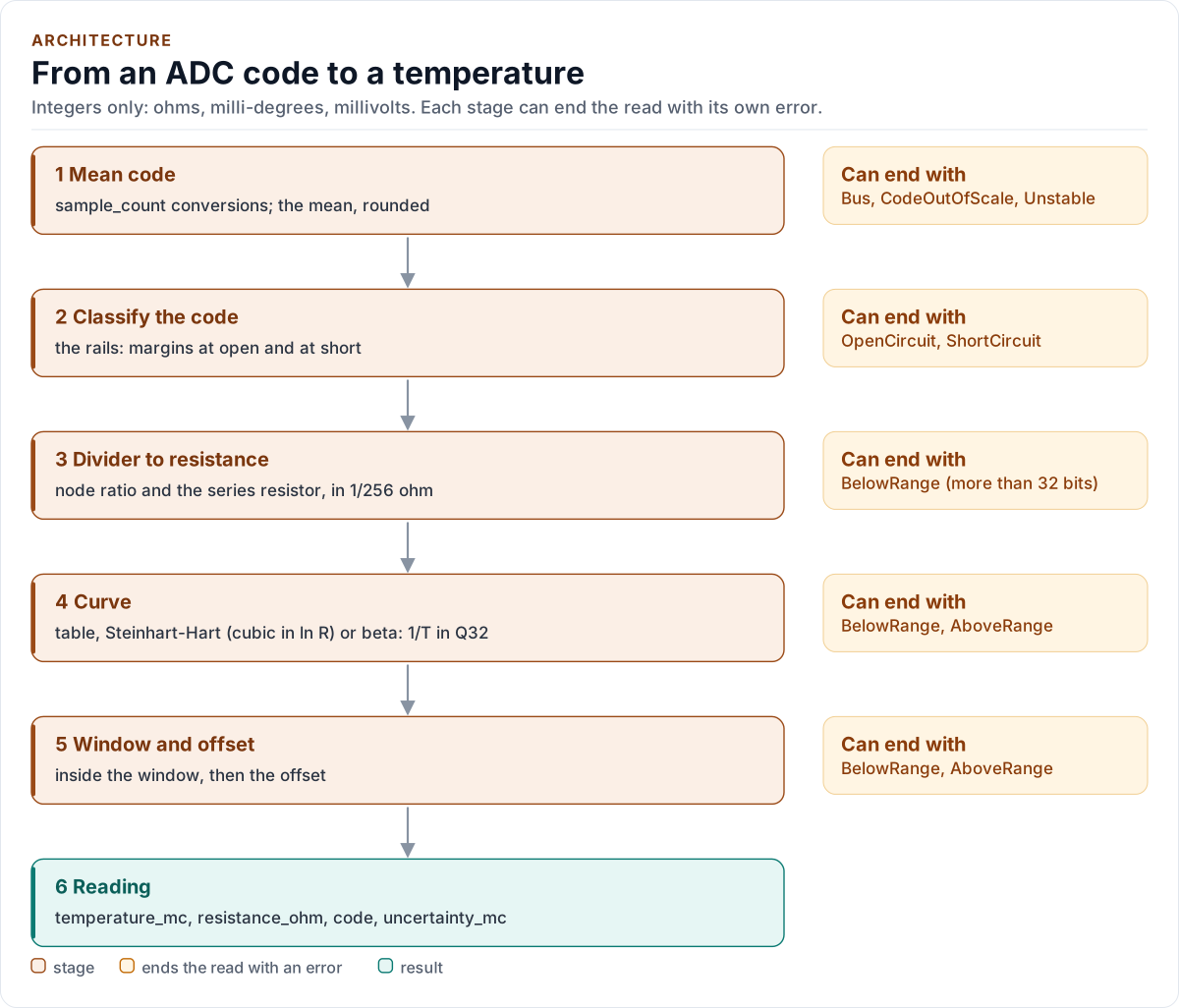
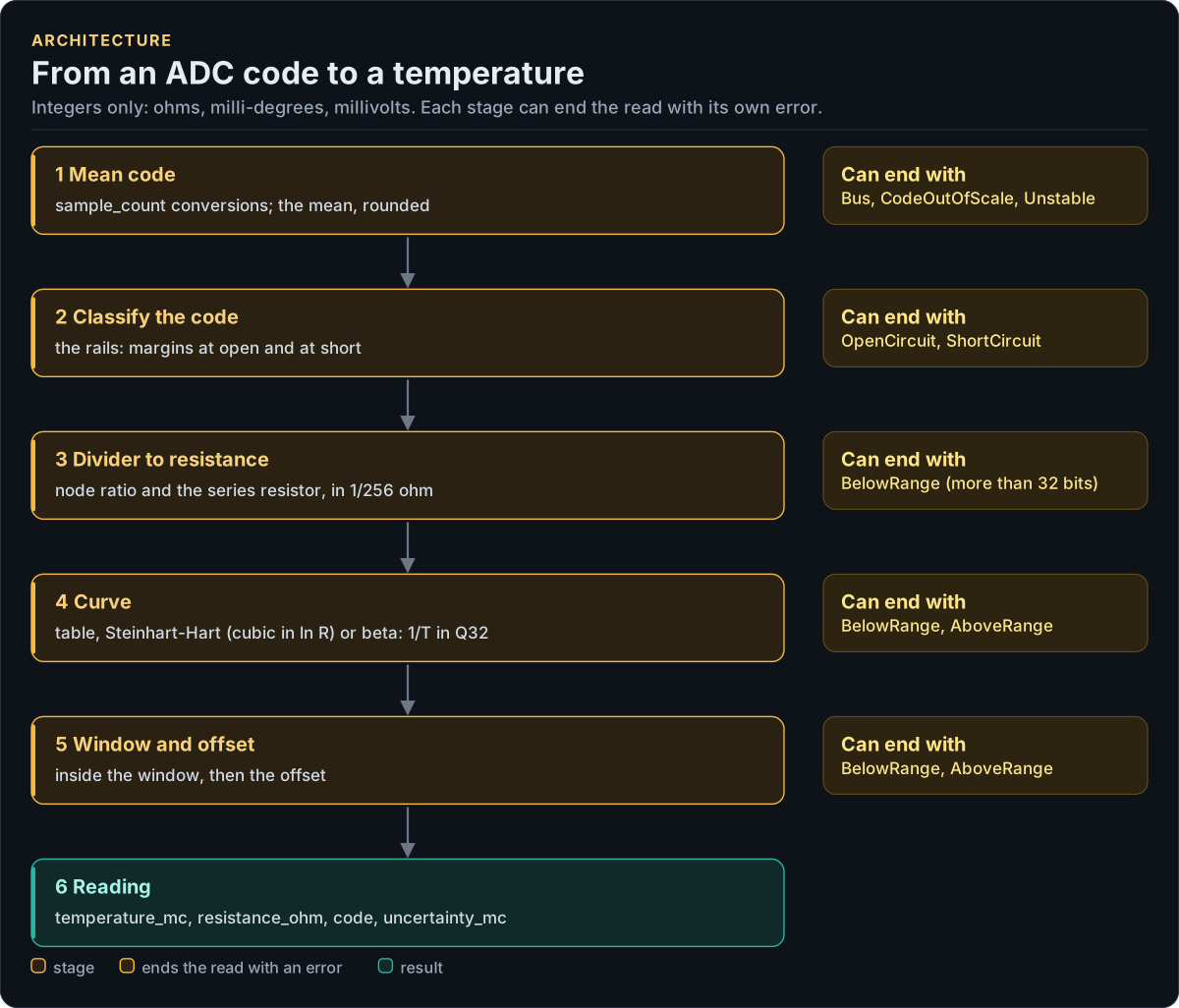
Figure description and sources
Top to bottom, each arrow hands one number to the next stage. Read() takes sample_count codes and their mean (the spread check can stop it as Unstable). The mean code is classified: at or above 2^bits is CodeOutOfScale, a code in the margin at the open rail is OpenCircuit, one in the margin at the short rail is ShortCircuit; which rail is which depends on the divider side. The node ratio gives the thermistor's resistance from the series resistor, in 1/256 ohm. The resistance goes through the curve: a table (a bounded binary search, then linear interpolation in ln R) or Steinhart-Hart (a cubic in ln R) or the beta equation (1/T in Q32), any of them with no floating point and no library. The temperature must lie inside the window; the offset is added last. The uncertainty bound is computed from the same code. The stages are the functions of inc/ntc_thermistor_conversion.hpp.
Drawn from: inc/ntc_thermistor_conversion.hpp ConvertCode(); inc/ntc_thermistor_conversion.hpp FineOfCode(); inc/ntc_thermistor_conversion.hpp CurveTemperature(); figure module docs/diagrams/figures/conversion-pipeline.py.
Rules the code keeps
- Integer only. Resistance in ohms (1/256 inside), temperature in milli-degrees, voltage in millivolts, tolerance in
parts per million. No
float, nodouble, no library math. - A part is data. Nothing in
inc/orsrc/names a part; the presets areCurvevalues. - Bounded. Every loop has a constant bound: the table search is at most 8 steps,
Ln16()a fixed number of steps. - Port-independent code stays outside the class template.
Next: Contract.