Contract
What the AT25040B driver promises, what it needs, and the rules a caller follows.
The driver inherits the Kokeb Labs driver contract; this page states only what is specific to it. A change to anything here is a breaking change, listed under Breaking in the changelog.
Datasheet sections this page relies on
From Microchip (Atmel) Atmel-8707 F:
- Write enable latch, WREN and WRDI: 6 Functional Description, Write Enable (WREN), Write Disable (WRDI), p. 8
- Status register, RDY and the all-ones status of a write cycle: 6 Functional Description, Tables 6-2 and 6-3, p. 8
- Page write, the page wrap and the self-timed write cycle: 6 Functional Description, Write Sequence (WRITE), p. 9
All of them, with the driver API for each: Datasheet map.
Promises
- The constructor is
noexcept, does no I/O and cannot fail. No call clocks the bus beforeEnsureInitialized(), so the driver can be constructed statically even where MISO may float. EnsureInitialized()runs the identity check below and nothing else; it never sends WRITE or WRSR. On any failure the driver stays uninitialised, and the next call starts again.- Every call that touches the chip returns
Error::NotInitializedbeforeEnsureInitialized()succeeds and sends nothing. No call starts the chip as a side effect. - Every port failure propagates: a failed transfer as
Error::Bus, a failed WP pin write asError::Pin. When a step fails and parking WP fails too, the call returnsPin(WP may be left released) and logs both. A failedRead()leaves its buffer zeroed, never partial data. - Before each array access and after each write the driver reads the status until no write cycle runs (at most
Config::write_timeout_us), and an idle status counts only when a second read gives the same byte. It never sends an instruction a busy chip would ignore. Write()never sends a WRITE that crosses a page, never writes outside the requested range, and refuses a range in the block-protected part before it sends WREN. It returns only after the last write cycle has ended.Read()andWrite()send only what the datasheet needs, plus the status reads above, unless the call asks for more. Verification is chosen per call: withVerify::ReadBack, one corrupted transfer never makesRead()return wrong bytes withOk, and never makesWrite()returnOkfor bytes the chip does not hold. WithVerify::None, the default, a corrupted READ reaches the caller (check a CRC over the data), and a WRITE the chip ignored is still caught by the WEN check after its write cycle.- WP is high only during a write, a block-protection change and the identity check, and parked low after each of them, on success and on failure. A failure after WREN sends WRDI, so the latch is not left set.
SetBlockProtection()is the only call that sends WRSR, and only when the level changes.- A missing
DelayUs()is a compile error; a missingGpioSet()leaves WP to the board; a missingLog()logs nothing. A misdeclared hook is a compile error. - The driver never retries a call. Retries are the caller's choice (API guide).
The identity check
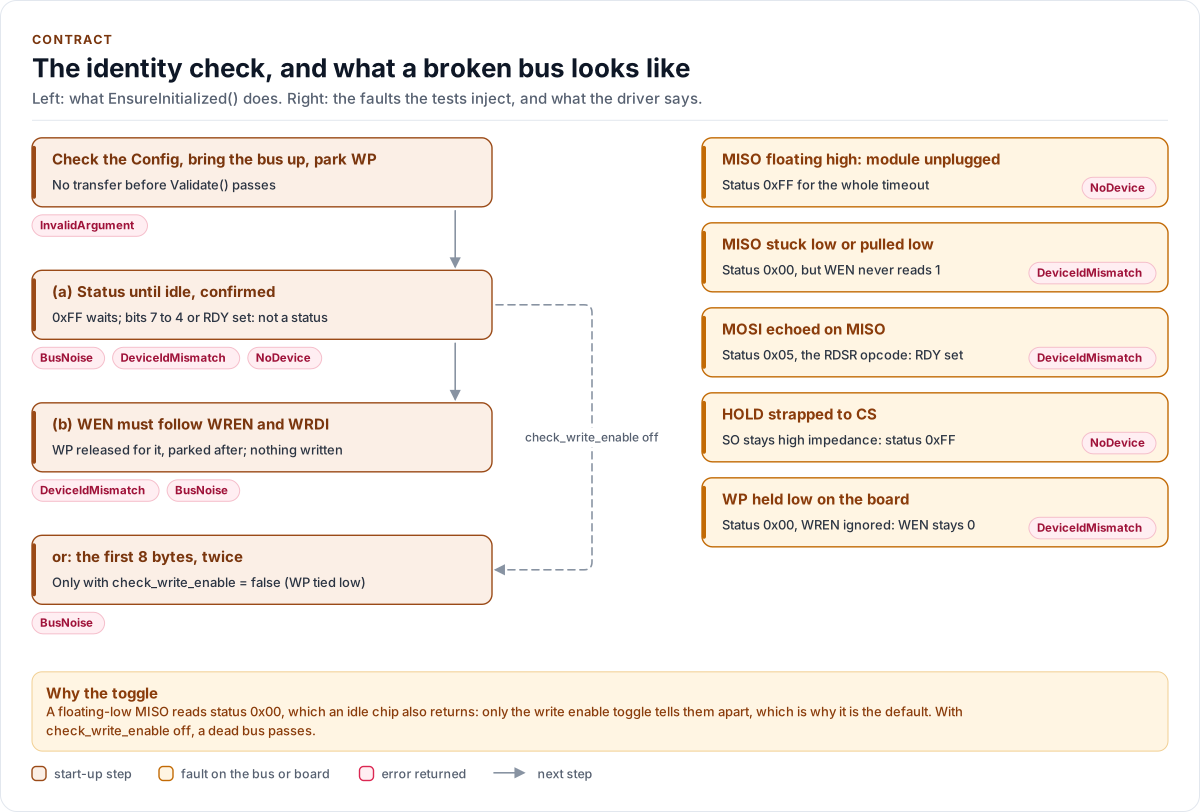
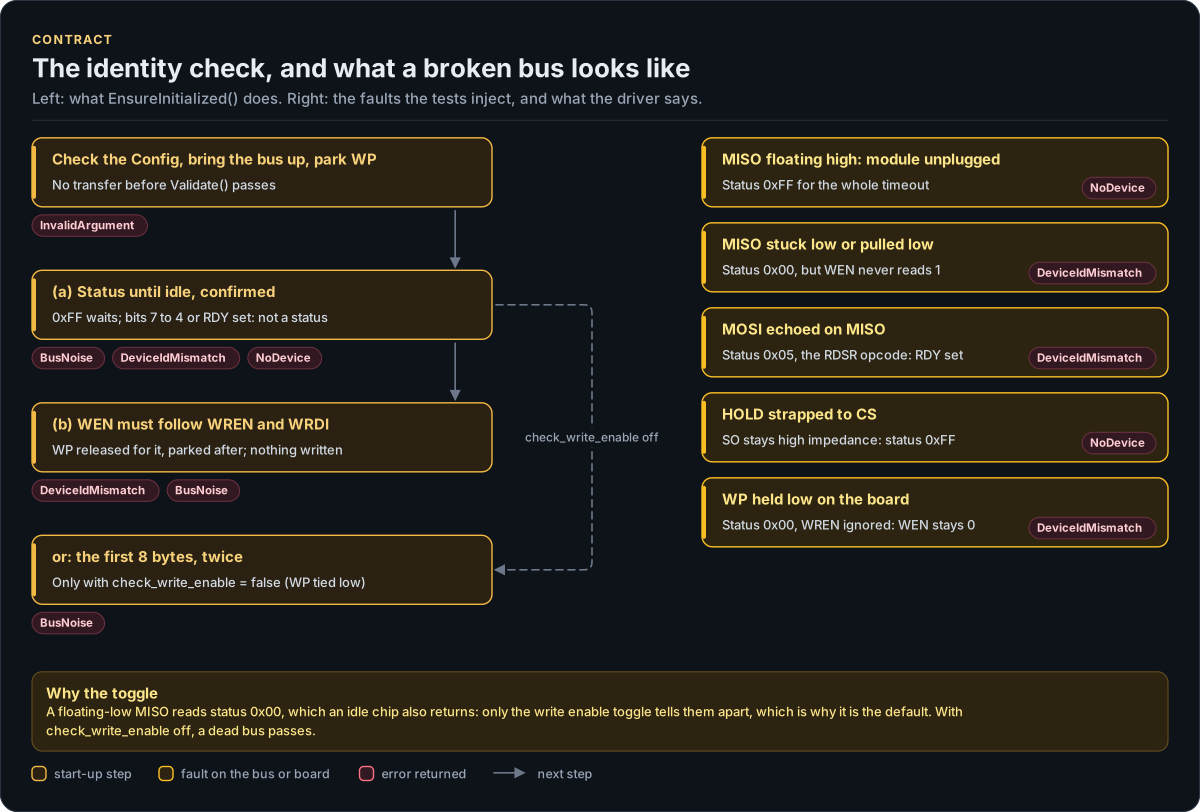
Figure description and sources
The left column is the start-up as the driver runs it, top to bottom; a pill names the error a step returns, and any step that sends a transfer also returns Bus when it fails. The status is read until it is not busy, for at most Config::write_timeout_us, and an idle status counts only when a second read gives the same byte. With Config::check_write_enable (the default) WP is released, the latch cleared first if it was set, then WREN must show WEN = 1 and WRDI WEN = 0, and WP is parked again; nothing is programmed. Without it, for a board whose WP is tied low, the first kIdentityReadBytes are read twice and must match, a weaker test. The right column lists the bus and board faults the host tests put on the chip model, each with the status byte the driver saw and the error EnsureInitialized() returned, read from the test cases in tests/test_at25040b.cpp. The steps come from initialize(), checkWriteEnableToggle(), checkStableHead() and waitIdle() in src/at25040b.ipp.
Drawn from: src/at25040b.ipp initialize; src/at25040b.ipp checkWriteEnableToggle; src/at25040b.ipp checkStableHead; src/at25040b.ipp waitIdle; tests/test_at25040b.cpp start-up fault tests; figure module docs/diagrams/figures/identity-check.py.
The AT25xxxB family has no ID register, so EnsureInitialized() checks behaviour the datasheet guarantees,
strongest test first:
- The status, read until idle and confirmed. Bits 7 to 4 read 0 when no write cycle runs, and every bit reads
1 during one (Table 6-3). The driver reads the status until it is not 0xFF (a write cycle may still run after an
MCU reset), for at most
Config::write_timeout_us, then once more: both reads must be the same idle status. 0xFF throughout isNoDevice(MISO floating high); 0x05 (the RDSR opcode echoed from MOSI) or any byte with bits 7 to 4 or RDY set isDeviceIdMismatch; two different idle bytes areBusNoise. - The write enable latch follows WREN and WRDI (
Config::check_write_enable, the default). WP is released, the latch cleared first if it was already set, then WREN must make WEN read 1 and WRDI must make it read 0, and WP is parked again. Nothing is programmed. A MISO stuck low reads 0x00, which passes step 1 like an idle chip, but it can never show WEN = 1: WEN is set only by a WREN the chip received with WP high (section 6, "Write Enable"; Table 6-2), so it proves that a chip, not a line, answers. - Without step 2, for a board whose WP pin is tied low (the chip then never sets WEN), the first
kIdentityReadBytes(8) are read twice and must match (BusNoiseotherwise). This is weaker: a dead bus with MISO stuck low passes it.
The check cannot tell the part's size, so Config::variant is trusted.
Depends on
| Dependency | Version | Why |
|---|---|---|
| A C++20 compiler | GCC 10, Clang 13 or later | Concepts constrain the port |
| CMake | 3.16 or later | Generates at25040b_version.h |
| Your port | The bus, a delay, optionally the WP pin and logging (Porting) |
Nothing else: no RTOS, no SDK, no other repository of the org.
Threading
The driver is not thread-safe and takes no lock. Use each driver object from one task at a time, or guard every
call on it with one mutex; the layer that owns the driver owns that lock, and the bus lock when several chips share a
bus. Nothing may run in an ISR: every call can block for transfers and, for a write, for the write cycles (about
5 ms per page at most, Config::write_timeout_us per page in the worst case). Separate objects share no state.
Timing
| Call | Transfers | Waits |
|---|---|---|
EnsureInitialized() |
6 (8 if the latch was set) | Only while a write cycle runs |
Read() of n bytes |
2 + ceil(n / 16); 2 + 2 x ceil(n / 16) with Verify::ReadBack |
Only while a write cycle runs |
Write() of p pages |
2 + 5 x p, plus status polls; 2 + 6 x p with Verify::ReadBack |
Each write cycle, polled every 100 µs |
SetBlockProtection() |
7, plus status polls (2 when the level is already set) | One write cycle |
GetBlockProtection(), ReadStatus() |
2, 1 | GetBlockProtection() only while a cycle runs |
With Verify::None the transfers beyond the datasheet's own sequence are: the second, confirming status read before
a Read() or Write() and after each write cycle (one corrupted read must not let the driver send a READ or WREN
to a busy chip, which ignores it: found by the fuzzer), and the status read after each WREN (WEN = 1, so WP low is
WriteProtected before a WRITE is sent). The WEN = 0 check after a write cycle reuses the last status read.
Config::check_write_enable adds nothing to Read() or Write(): it runs once, in EnsureInitialized().
Why the status read after each WREN is not opt-in. The datasheet requires a WREN before every WRITE, and the latch
clears at the end of each write cycle, so a WREN per page is part of the datasheet's sequence. The status read after it
is one more short transfer. Each page then waits for its self-timed write cycle, up to 5 ms, which makes that read a
small fraction of the page's time. In return a chip that did not take the WREN (WP held low, a broken MOSI) is
reported as WriteProtected before the WRITE is sent, instead of a write that silently did nothing. EEPROM writes
are not a timing-critical path, so this check stays on every page. Opt-in verification (Verify::ReadBack) is for
checks that cost a read of the data itself.
Errors
at25040b::Error inside at25040b::Result<T>. Values 0 to 9 are the shared base set; this driver returns six of
them, plus six chip-specific values.
Error |
Value | Returned when |
|---|---|---|
Ok |
0 | The call succeeded |
NotInitialized |
1 | EnsureInitialized() has not succeeded, or Deinitialize() ran since |
InvalidArgument |
2 | A Config field fails Validate(), an address range leaves the array, an empty range, or a block-protection level that is not one; nothing was sent |
Bus |
3 | A transfer, or the port's bus bring-up, failed |
Timeout |
4 | After the start, the status read busy for longer than Config::write_timeout_us: a write cycle that does not end, or the module was unplugged since |
DeviceIdMismatch |
5 | At start-up, a status byte that is neither idle nor busy, or the latch did not follow WREN and WRDI |
Crc |
6 | Never returned: the chip sends no CRC |
Busy |
7 | Never returned: every call waits for a running write cycle instead |
DeviceFault |
8 | Never returned: the chip reports no faults |
Unsupported |
9 | Never returned: the driver has no optional feature |
NoDevice |
16 | At start-up, the status read 0xFF for the whole timeout: nothing drives MISO |
BusNoise |
17 | Two reads of the same thing differed, or after the start a status byte was neither idle nor busy |
WriteProtected |
18 | WREN did not set WEN: WP is low, or the WREN frame was lost; nothing was written |
BlockProtected |
19 | The range lies in the block-protected part; only the status was read |
WriteMismatch |
20 | The read-back differed, the latch was still set after a WRITE (the chip ignored it), or BP1:BP0 did not take |
Pin |
21 | The port's GpioSet() could not release or park WP (handbook KB-CPP-047) |
The API guide says what to do about each.
Memory
No heap, no exceptions, no RTTI, no std::function, no std::string, no printf and no static mutable state. A
driver object holds a reference to the port, its two 18-byte transfer buffers (the only memory the port sees), a
Config, the last status byte and a flag: about 56 bytes on a 32-bit MCU. Stack use is small and fixed: a 16-byte
compare buffer in Read() with Verify::ReadBack, an 8-byte one in Write().
Platform
Platform-free: the same code runs on any target with a C++20 compiler, including the host tests. The ESP-IDF port
in examples/esp32 is an example, not part of the driver.
Deviations from the standard
| Rule | Deviation | Why |
|---|---|---|
| A chip-ID check at start-up | Replaced by the behaviour check above | The chip has no ID register |
| A reset at start-up | None | The chip has no reset; it powers up with the latch clear (section 6, "Write Enable") |
Config{} equals the chip's reset state |
Config describes the board (variant, WP wiring, checks), not chip registers |
The only setting, BP1:BP0, is non-volatile and is never written by EnsureInitialized() |