Architecture
How the driver is built: the core, the port contract, and your port.
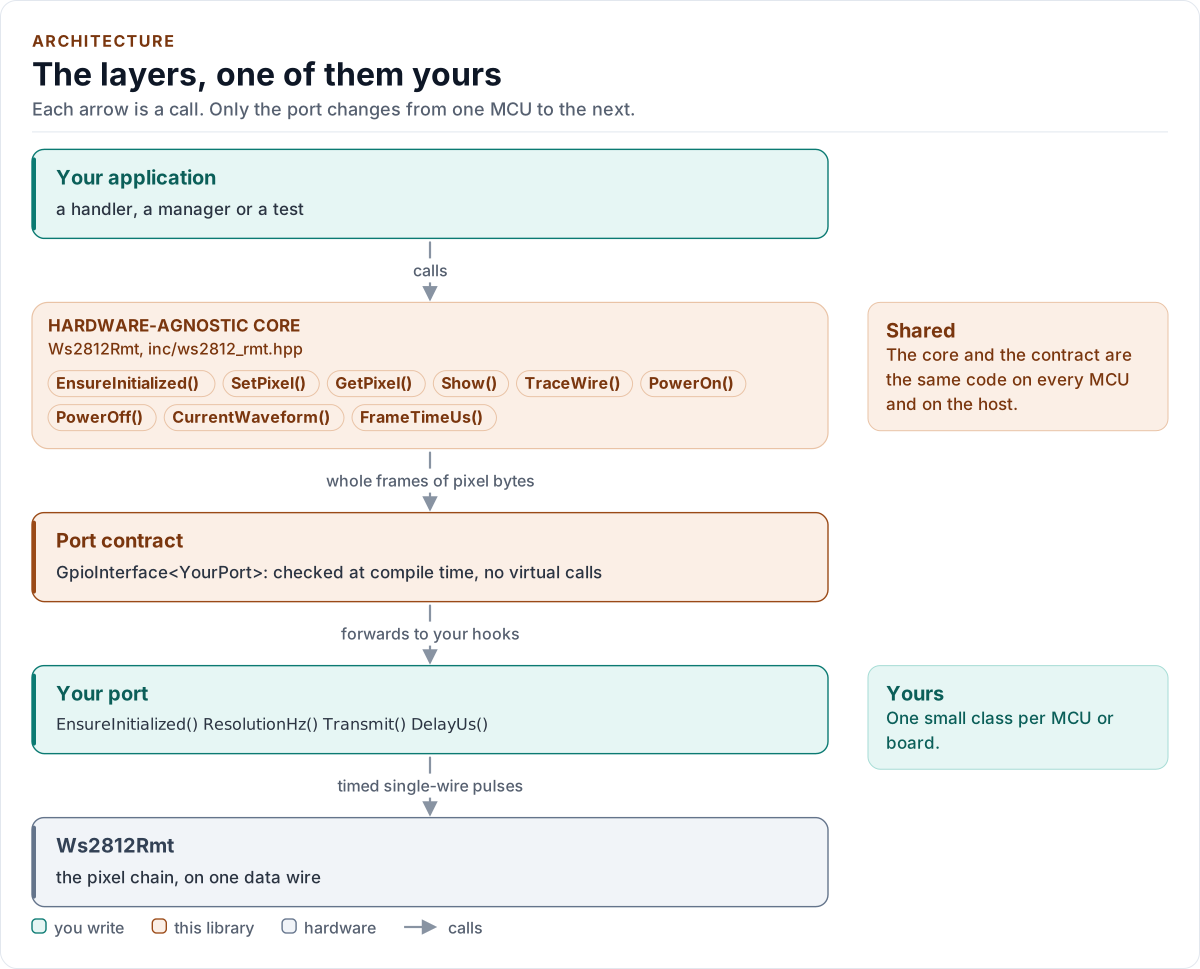
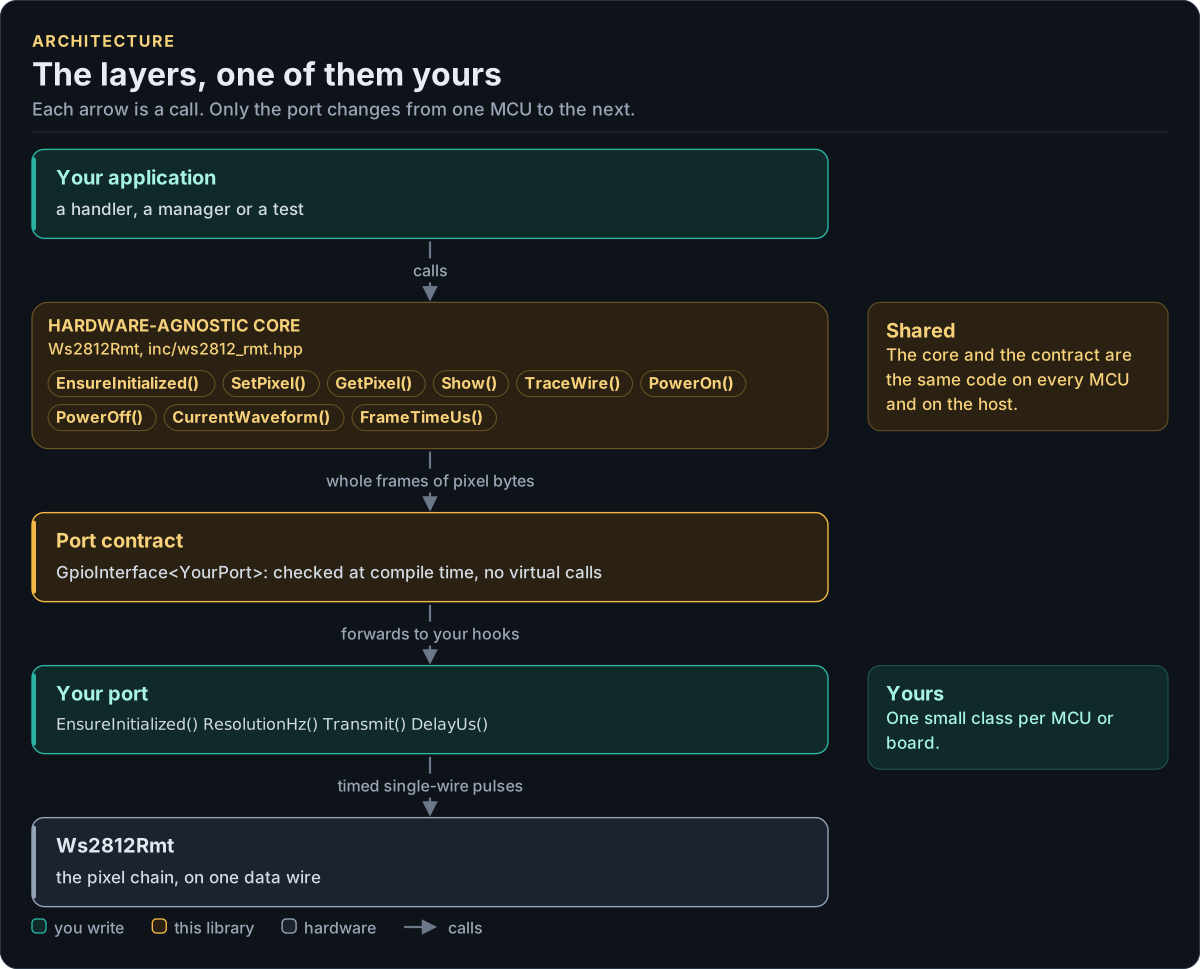
Figure description and sources
Top to bottom, each arrow is a call. Your application calls one object, whose public calls are listed from the umbrella header in inc/. The core turns each call into register reads and writes and hands them to the port contract (the CRTP base in inc/*_interface.hpp), which forwards them, at compile time, to the hooks of the port class you write; your port moves the bytes on the bus. The notes on the right say which layers stay the same on every MCU and which one you write. A library without a port contract has only the first two layers.
Drawn from: inc/ws2812_rmt.hpp public calls; inc/ws2812_rmt_gpio_interface.hpp GpioInterface; figure module docs/diagrams/figures/driver-layers.py.
| Layer | Files | Owns |
|---|---|---|
| Core | inc/ws2812_rmt.hpp, src/ws2812_rmt.ipp |
Lifecycle, the pixel and wire buffers, Show(), power |
| Pure functions | inc/ws2812_rmt_functions.hpp, inc/ws2812_rmt_gamma.hpp |
Waveform resolution, encoding, frame time, Validate(), the gamma table |
| Types | inc/ws2812_rmt_types.hpp |
Error, Result<T>, Colour, Timing, the profile table, Waveform, Config |
| Port contract | inc/ws2812_rmt_gpio_interface.hpp |
The CRTP base, CtrlPin, GpioSignal, the Ws2812RmtPort concept |
| Platform port | Your class | The channel, the tick rate, the stream, optionally the supply pin |
The part has no read-back, so there is no register map and no frame to parse: the core writes a byte stream and
decides what waveform it is sent with. The functions are free constexpr functions with no state, so the tests
check each against an independent oracle and a fixed configuration can be proved at build time.
One call, in order
SetPixel()and friends store logical colours. No I/O.Show()walks the pixels once, applies gamma then brightness, writes the bytes in the configured order into the object's wire buffer, and gives the port the span, the resolved waveform and a timeout.- The port sends the stream and the reset, and returns
trueorfalse.
The waveform is resolved once, at EnsureInitialized(), from the windows and the tick rate. It is not recomputed
per frame, and it is not changed by anything the caller can set after that.
Why a capacity template argument
The driver owns its buffers (no heap, no caller-owned span that could dangle, handbook KB-CPP20-044), so the capacity
is a template argument. A smaller Config::pixel_count uses part of it. One object serves one strip.
Next: Contract.