Architecture
How the driver is built: the core, the port contract, and your port.
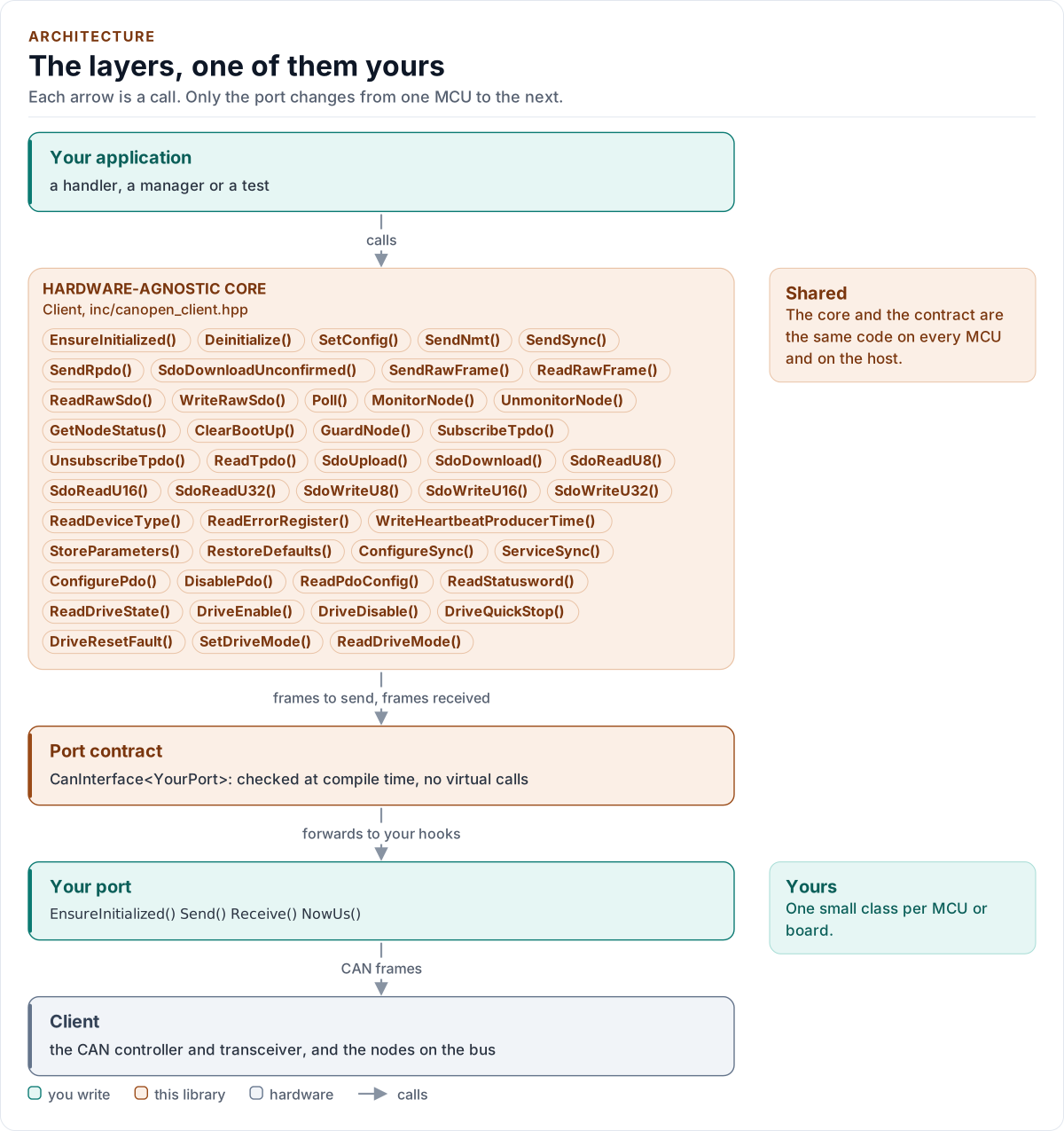
Figure description and sources
Top to bottom, each arrow is a call. Your application calls one object, whose public calls are listed from the umbrella header in inc/. The core turns each call into CAN frames (SDO requests, NMT commands, SYNC, PDOs) and hands them to the port contract (the CRTP base in inc/*_interface.hpp), which forwards them, at compile time, to the hooks of the port class you write; your port puts each frame on the bus and hands received frames back. The notes on the right say which layers stay the same on every MCU and which one you write. A library without a port contract has only the first two layers.
Drawn from: inc/canopen_client.hpp public calls; inc/canopen_client_can_interface.hpp CanInterface; figure module docs/diagrams/figures/driver-layers.py.
| Layer | Files | Owns |
|---|---|---|
| Core | inc/canopen_client.hpp, src/canopen_client.ipp |
Client<Port>: lifecycle, the one request in flight, SDO transfers, the receive router, node table, EMCY queue, PDO configuration, the drive state machine |
| Protocol | inc/canopen_client_protocol.hpp |
Pure constexpr frame builders and parsers: NMT, SDO, heartbeat, EMCY, SYNC, PDO, statusword decode; no state, no port |
| Types | inc/canopen_client_types.hpp |
Error, Result<T>, Config, presets, identifiers, capacities |
| Port contract | inc/canopen_client_can_interface.hpp |
The CRTP base, the CanPort and CanRxPort concepts |
| Platform port | Your class | The CAN controller: EnsureInitialized, Send, Receive, NowUs, optionally Log |
Two port levels
A port with EnsureInitialized() and Send() satisfies CanPort: the client can command (SendNmt, SendSync,
SendRpdo, SdoDownloadUnconfirmed). Adding Receive() and NowUs() satisfies CanRxPort and enables everything
that needs a reply: SDO, heartbeat, guarding, EMCY, TPDO, PDO configuration and the drive helpers. A call that needs a
reply on a send-only port does not compile; a port that has only one of Receive and NowUs is refused by a
static_assert.
One request in flight
The client runs one SDO transfer at a time and every call blocks until it ends. While it waits for a reply, other
frames that arrive are not lost: heartbeats update the node table, EMCY frames are queued and TPDOs are stored, and a
flood of unrelated frames cannot hold a request past its timeout (Stats::flood_aborts). The driver starts no thread,
sleeps only through the port's Receive() and takes no lock.
Fixed capacities
| Resource | Capacity | Full means |
|---|---|---|
| Monitored nodes | 16 (kMonitorCapacity) |
MonitorNode() returns BufferTooSmall |
| Subscribed TPDOs | 16 (kPdoSubscriptionCapacity) |
SubscribeTpdo() returns BufferTooSmall |
| Queued EMCY events | 8 (kEmcyQueueCapacity) |
The oldest are kept; new ones are dropped and counted in Stats::emcy_dropped |
| Entries in a PDO mapping | 16 (kMaxPdoEntries) |
ValidatePdoConfig() refuses it |
Next: Contract.